
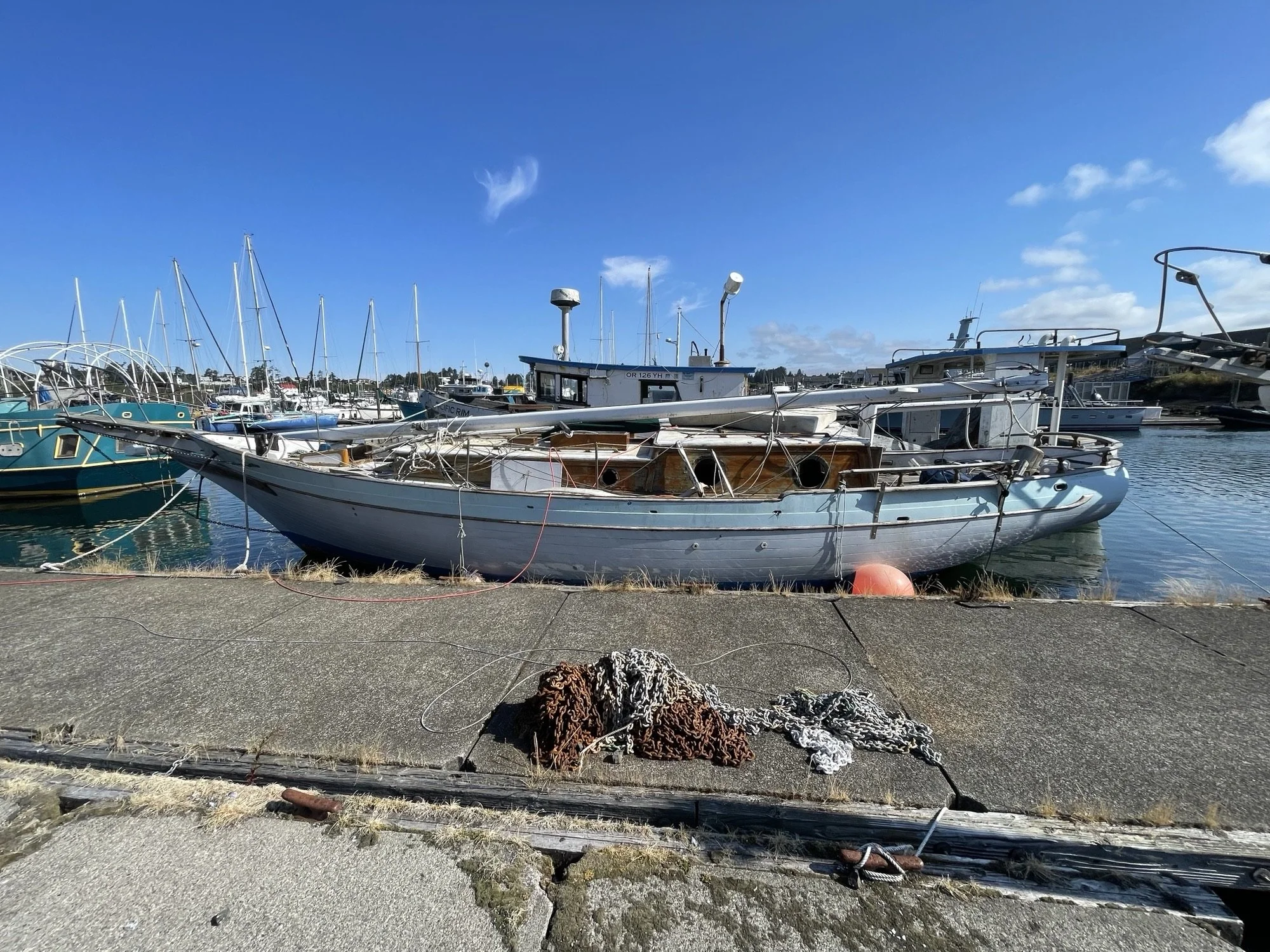
Abandoned vessels in Port of Newport (Courtesy of Port of Newport)
BOLI Reverses Ruling That Derelict Vessel Removal Is Subject to Prevailing Wages
By Nigel Jaquiss
March 2, 2026
The Oregon Bureau of Labor and Industries has reversed an earlier finding that the Port of Newport should pay prevailing wages for the removal and disposal of derelict boats from port waters.
“On December 11, 2025, BOLI issued a determination that the prevailing wage rate (PWR) laws would apply to the project. The purpose of this letter is to notify you that BOLI has amended its determination,” Oregon Labor Commissioner Christina Stephenson wrote in a Feb. 19 letter to the port’s contractor.
“Upon further review of the project, BOLI has determined the project is not subject to Oregon’s prevailing wage rate laws.”
The reversal is notable for a couple of reasons. First, it will save the Port of Newport a “significant” amount of money on vessel removal, which is budgeted at $360,000, says Paula Miranda, executive director of the port. That savings will extend statewide in the future.
The Oregon Department of State Lands, which regulates the state’s public waterways, says hundreds of derelict vessels pose both navigational and environmental hazards at the state’s 23 public ports and numerous lakes and rivers.
The Legislature appropriated $19 million for removal of junk boats in 2023, but everybody involved agrees the long-term cost of removing all those vessels will be much higher than that—so the cost savings from the Newport ruling will have a multiplier effect across the state, Miranda says.
“It is a significant savings for all ports,” she says. “There are going to be a lot of vessels removed and they just keep coming.”
While the reason for the change in BOLI’s position remains unclear, OJP first shined a light on the issue in January, when it reported on BOLI’s initial determination that Newport must pay prevailing wages for boat removal.
BOLI regulates workplace laws, including prevailing wage. That law requires, in part, that publicly funded projects involving the construction or demolition of “structures” pay prevailing wages, which are typically union wages and substantially higher than nonunion wages.
In response to BOLI’s initial determination, an attorney representing the Oregon Public Ports Association submitted a letter to the agency disputing BOLI’s premise.
“Removal of derelict vessels does not involve work on a ‘structure’ as a vessel is not a ‘structure’ under state or federal maritime law,” Oregon Public Ports Association attorney Darien Loiselle wrote in a December letter.
BOLI apparently agreed, although the agency did not include an explanation in its Feb. 19 amended determination. (BOLI did not respond to a request for comment for this story.)
“All of a sudden they changed their mind, but they never gave us a reason,” Miranda says. “In any case, we are thrilled.”
The Newport case marks a rare instance in which BOLI reversed an initial determination, according to a review of past findings and people familiar with the agency. As OJP has reported, the large increase in state funding for affordable housing projects has made the agency a flash point for builders who believe BOLI’s prevailing wage interpretations are adding unnecessary costs to projects and, in some cases, preventing them from being built. BOLI disagrees with critics, saying it is merely following the laws the Legislature writes.
Senate Bill 1566, which would have clarified some of the most contentious aspects of prevailing wage law, died in committee this month after spirited debate between housing developers and social service providers on one side and trade unions, whose members benefit from prevailing wages, on the other.
Oregon Public Broadcasting reported last week that a chief co-sponsor of the bill, state Sen. Dick Anderson (R-Lincoln City), is so frustrated by the agency’s stance on prevailing wage law that he is considering a challenge to incumbent BOLI Commissioner Stephenson’s reelection bid later this year.
Correction: This story originally stated that Sen. Dick Anderson would risk his Senate seat if he challenges Labor Commissioner Christina Stephenson. In fact, Anderson is mid-term and can run without risking his seat. OJP regrets the error.