
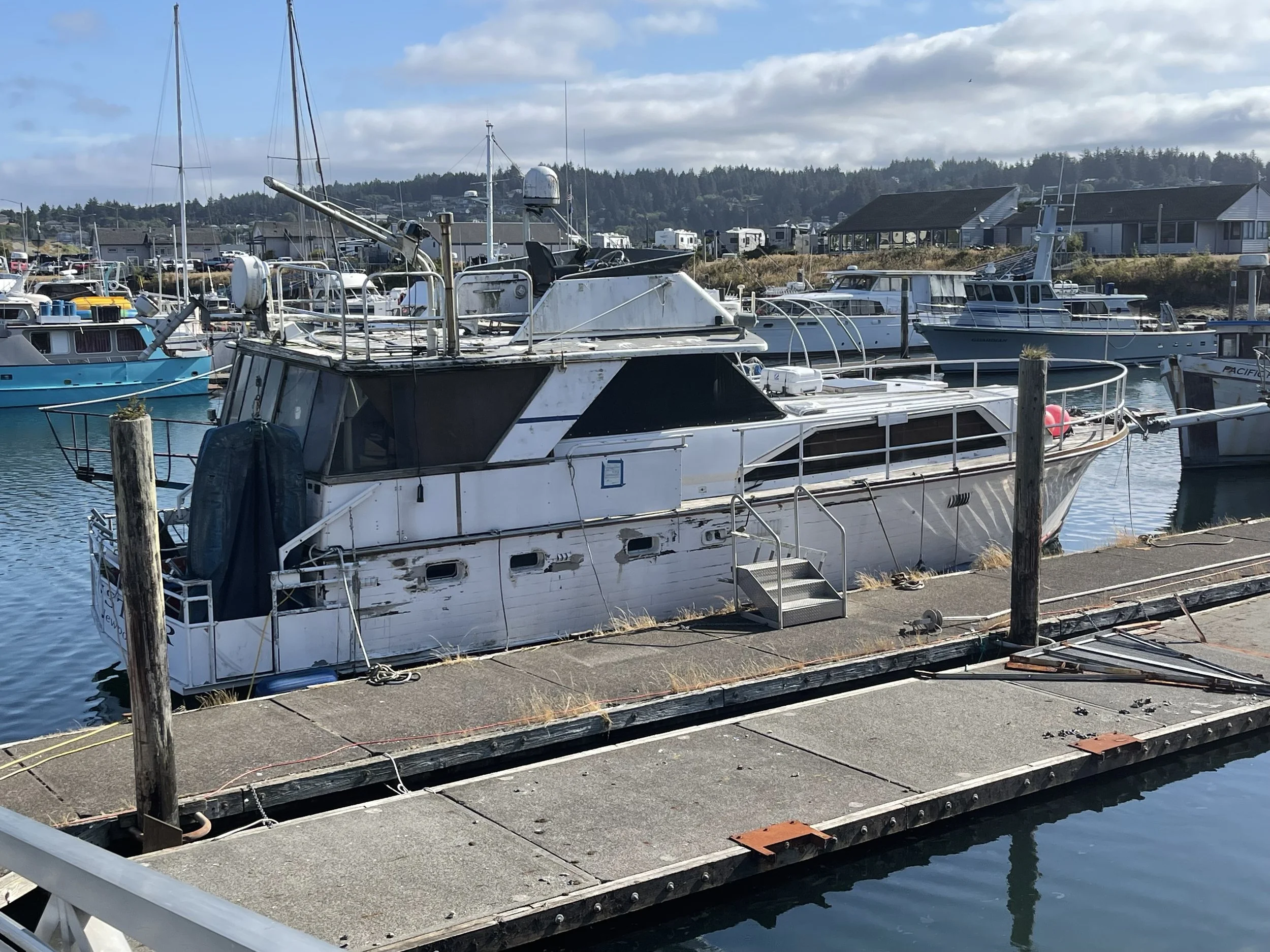
Abandoned vessels in Port of Newport (Courtesy of Port of Newport)
BOLI Orders Contractor to Pay Prevailing Wages to Remove Derelict Boats
The ruling catches Oregon ports by surprise and could slow the removal of junk vessels from navigable waterways.
By Nigel Jaquiss
January 22, 2026
Three years ago, the Legislature accelerated the messy job of removing derelict ships and boats that clog waterways across the state: sailboats in the Willamette River; abandoned tugs in Coos Bay; rotting fishing boats in Newport; rusting barges on the Columbia River.
Lawmakers in 2023 allocated nearly $19 million to remove and demolish the abandoned vessels. The Department of State Lands, which oversees Oregon’s waterways, quickly began the work, removing large junk boats from waters near Coos Bay, Rainier and St. Helens. It’s difficult and expensive work—getting rid of a single derelict vessel, the FV Tiffany, an 84-year-old, 200-ton fishing boat that sank on the Columbia River near Rainier, cost $1.42 million in 2023.
To date, some of the highest-profile abandoned vessels have been removed, but there are hundreds more to go. In December, the Oregon Bureau of Labor and Industries suddenly increased the costs of the work, angering local government officials at Oregon’s 23 public ports.
Specifically, BOLI decided that the removal program, which has been underway for more than two years, must now pay prevailing, i.e. union, wages to the private contractors who do the work.
The decision cast a cloud over plans to remove 17 derelict vessels from the Port of Newport because the change would add costs and recordkeeping requirements. (Studies in other industries show that prevailing wages can add 10% to 20% to total project costs.)
“It makes no sense to us,” says Paula Miranda, executive director of the Port of Newport, home to the state’s largest fishing fleet. “This just makes things worse.”
Port managers responsible for getting rid of the fleet of junk vessels say BOLI’s ruling is wrongheaded and will slow the response to a chronic problem.
Since BOLI Commissioner Christina Stephenson won election in 2022, her agency has increasingly ruled that projects that use public money must pay union wages. That has pleased the trade unions that supported Stephenson, a Democrat (most of the $1.8 million she raised for her election campaign came from unions), but it has also made that work more expensive. As the Oregon Journalism Project has reported, BOLI’s prevailing wage determinations on planned housing projects across the state have added costs to many and caused others to be delayed or canceled.
The agency had not previously taken a position on boat removal work. But on Dec. 11, BOLI issued a ruling that Siletz Boat Works would have to pay prevailing wages on its work in Newport because getting rid of unwanted vessels would include demolition of “structures.” Generally speaking, BOLI requires public works projects, including construction or demolition of structures that spend at least $50,000 in public money, to pay prevailing wages.
Stephenson ruled that scrapping junk boats met the agency’s criteria. “‘Demolition’ includes the dismantling, razing, destroying, wrecking, or removal of buildings or other structures,” Stephenson wrote. “The common meaning of ‘structure’ is ‘something constructed or built,’” citing a dictionary definition.
Darien Loiselle, an attorney for the Port of Newport and the Oregon Public Ports Association, wrote to BOLI on Dec. 23 to strongly disagree. He contends that work done on navigable waterways is not governed by the state but by federal maritime law and that classifying derelict boats as structures is incorrect.
“Removal of derelict vessels does not involve work on a ‘structure’ as a vessel is not a ‘structure’ under state or federal maritime law,” Loiselle wrote. In his letter, the ports’ attorney asked for a hearing—effectively an appeal—of BOLI’s determination. (Loiselle did not respond to a request for comment.)
BOLI’s ruling came as a surprise to the port industry. Miranda, the Port of Newport chief, says if the agency’s determination stands, fewer derelict vessels would be removed because the prevailing wages the agency wants contractors to pay are significantly higher than market wages.
“This will deplete the amount of money the Department of State Lands has to spend,” Miranda says. “That means fewer vessels will get removed.”