
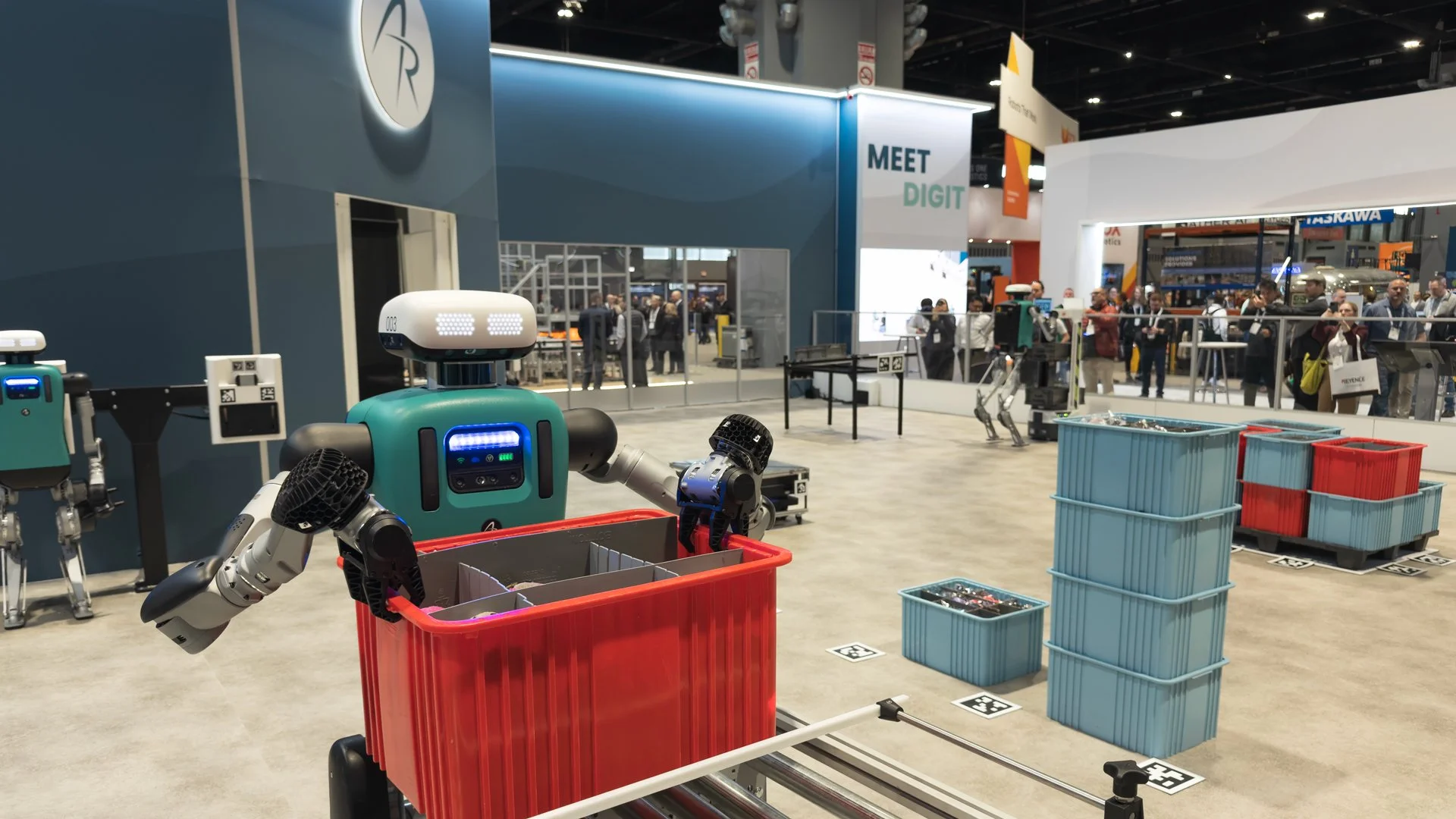
Agility’s flagship robot, “Digit,” is in experimental use in Amazon warehouses and Toyota manufacturing plants (Courtesy of Agility)
Spotlight: Jonathan Hurst
By OJP Staff
March 8, 2026
Jonathan Hurst is the co-founder and chief robot officer of Agility Robotics, a startup that began at Oregon State University and makes humanoid robots with artificial intelligence. The company, whose flagship robot, “Digit,” is already in experimental use in everything from Amazon warehouses to Toyota manufacturing plants, is one of the best funded startups in the history of the state.
Hurst, 46, is also professor of robotics at OSU. He joined the school as its first robotics professor in 2008 and helped build the university’s globally renowned robotics and AI programs.
While Hurst will not divulge details, analysts estimate that Agility has raised more than $640 million and is valued at approximately $2.5 billion. Hurst says Oregon State University owns some equity in the company.
OJP wanted to talk to Hurst about the state of robotics, the climate for growing a business in Oregon, the challenges he faces, and the social implications of robots in the workplace. The interview has been edited for brevity and clarity.
OJP: We realize that your company is far from profitable as a startup, but where is the company in terms of science and engineering?
Jonathan Hurst: Several years ago, we built Cassie, which, for the first time ever, had joints. Most robot arms are very, very rigid. But if you want a robot that can jump and bounce and move, you need that, and Cassie was among the very first that had that capability. We sold those to Caltech and Harvard and Berkeley and Michigan and others who have had robotics programs—and then we started building the humanoids, machines that we think, as engineers, are likely to be multipurpose and operate in human spaces. Now we use those machines to do proofs of concept. And our first real product, Digit v5, is coming out later this year. This robot will be the first that is really getting to the scaling point of us being able to make a lot of these and make sure that they are providing value to the customers. Our plan is to eventually make 10,000 a year.
Is the immediate identifiable market for robots in the workplace?
Humanoids are not going in the home anytime soon, and it’s because of the very real safety challenges. The chaos, the level of variety in a home, is something that robots simply cannot handle today and won’t for some time. And the cost. People aren’t willing to pay that much for a robot that can maybe fold their napkin or possibly fold 80, you know, fill 80% of their dishwasher, whereas that level of capability just for moving bins and totes, can capture half a million dollars of value over the course of a couple of years in a warehouse.
You are not from Oregon and graduated from Carnegie Mellon, one of the finest robotics schools in the country. Why did you decide to move here?
I came to Oregon to join Oregon State University, and one reason is quality of life. Oregon State had no robotics at all at the time, but I figured it was at least worth applying because they had an opening for a robotics professor. When I came in and visited for the interview and I brought that up, OSU was very clear: “No, we don’t have any robotics. So what do you want to do, and how can we help?” It was such an opportunity, it really felt like there’s fertile ground. OSU has 30,000 students, it’s a premier engineering institution. So, within the first year, I showed up and the robotics club went from two or three students to over 200 students in the robotics club. And then I built up a research program around legged locomotion, and the program has just continued to grow until we offered the master’s and Ph.D. program, only the third university in the country to offer a master’s and Ph.D.s in robotics. We now have something like 14 or 15 faculty now. Once we understood some of the core principles of leg and locomotion, we spun out the company, and I pulled a lot of my graduate students and people who’d worked for me as undergraduates or graduate students at the university to help us start the company. This was where we started it, this was where the seed was planted. That’s why we’re growing in Oregon, and that’s the only reason.
Oregon has a mixed reputation as a place to start and grow a business. Are other states more appealing?
All of our investors and all of our customers are out of state, and we generally have to recruit employees from out of state to come work here, and that’s actually been the biggest struggle in terms of being able to operate here. I’d like to try and do something about that. We’ve proposed some ideas about building an AI and robotics entrepreneurial program to start and create a real ecosystem of startups doing this work.
You mentioned a hard time finding employees, but you also mentioned a lot of talent coming out of Oregon State. Where’s the dichotomy?
It’s in the five to 10 years of industry experience that we need.
Have any investors come to you and said they will write you a big check to move the company?
You never really know why investors pass, but I am confident that being in Oregon is certainly a factor in the decisions that they make, not entirely negative.
How do you and your company think about workforce transition?
Every single one of the markets that Agility is going into has a massive worker shortage and the turnover is huge. The companies basically cannot provide the services that they want to provide because they aren’t really able to convince people to do these jobs, and if they had to pay them enough in order to get them to do whatever crummy job, then they also can’t afford to provide the service that they’re providing. It’s not about displacing people, it’s about even being able to provide the service that the companies want to provide in the first place.