
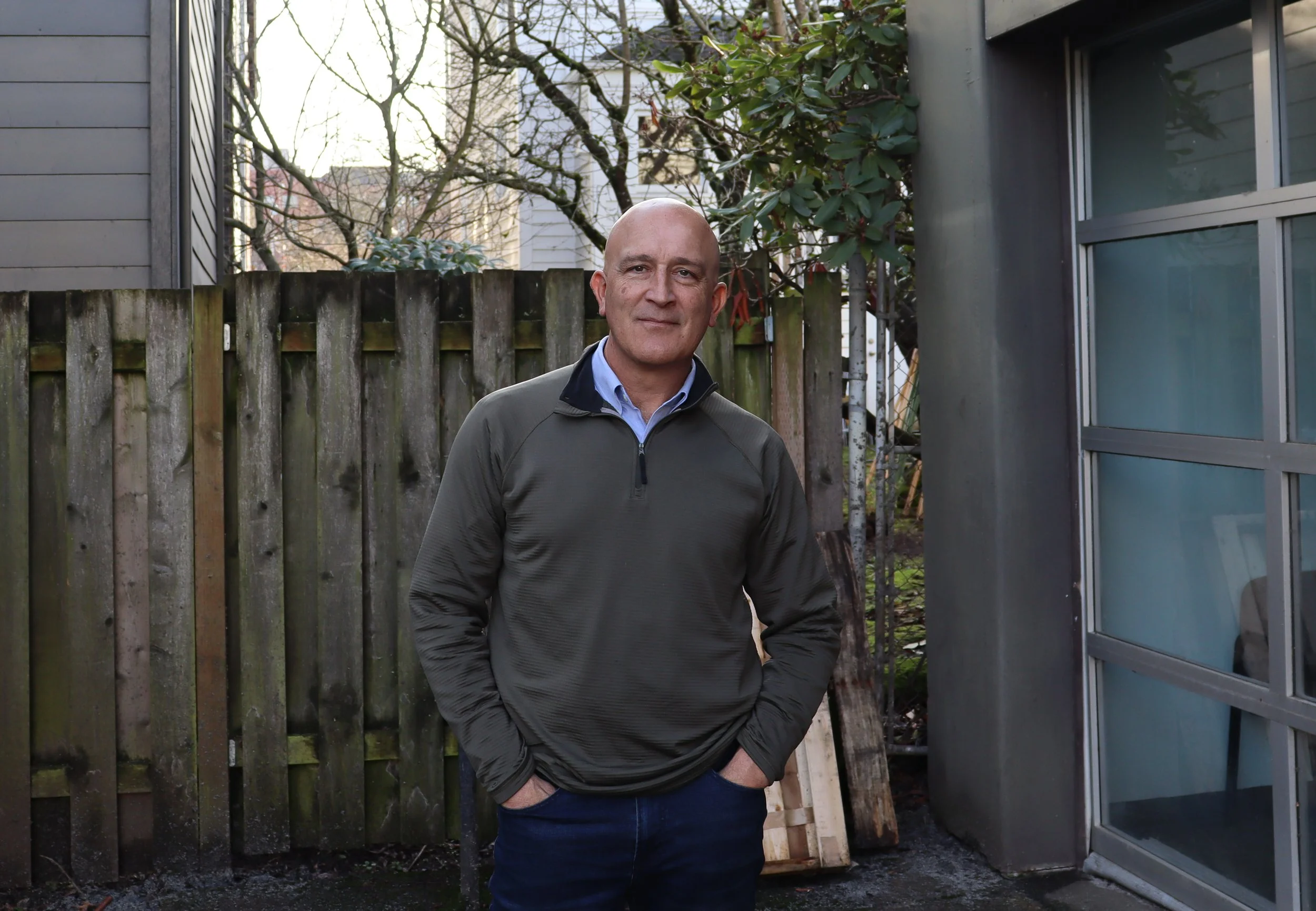
Senate Minority Leader Bruce Starr (Sophia Mick)
Spotlight: Bruce Starr
The Senate minority leader speaks out on gathering 250,000 signatures almost overnight and what’s wrong with Oregon.
By OJP Staff
January 13, 2026
Senate Minority Leader Bruce Starr (R-Dundee) is riding high. Along with state Rep. Ed Diehl (R-Scio) and Jason Williams of the Taxpayer Association of Oregon, Starr led a movement that turned in 250,000 signatures last month to refer controversial transportation tax hikes to the November ballot.
On Jan. 7, Gov. Tina Kotek caved. She now favors repealing the Oregon Department of Transportation funding package (House Bill 3991) that she and legislative Democrats worked so hard to pass.
For Starr, 57, it’s a bit of a comeback. The Oregon native and Portland State University graduate served in the Senate from 1999 to 2014—he worked alongside his father, former Sen. Charles Starr (R-Hillsboro)—then returned to the Capitol last year. Starr resumed a focus on transportation and quickly rose to the top of his caucus. He served as one of Republicans’ lead negotiators on HB 3991, which failed in the regular session but ultimately passed in a special September session.
OJP sat down with Starr for an interview that has been edited for brevity and clarity.
OJP: You were gone from Salem for a decade. Why’d you come back?
Bruce Starr: Because I was asked to, and public service is kind of built into my DNA. I also recognize that we’d lost a bunch of institutional memory.
How’s Salem different now?
I was in the minority most of the time before, but we weren’t in the superminority like now. I had really strong relationships across the aisle with what I would consider rational and moderate Democrats: Betsy Johnson, Rick Metsger, Lee Beyer, Joanne Verger. Those kinds of legislators are harder to find today.
Gov. Kotek now wants to repeal House Bill 3991. What’s your reaction?
It’s not surprising. The last thing the Democrat majority and this governor want is to be on the same ballot as a vote for their tax increase. So having the opportunity in a February session to undo the tax is certainly something that the majority can do.
Are you disappointed?
Sure. But I understand how the game is played. The reality is, we won. Oregon voters won—because this tax isn’t going to go into effect.
What will ODOT look like without the new tax money?
Well, the governor was somewhat ambiguous about repealing the bill. Does she want to repeal the entirety of the bill, or is she just going to focus on the taxes that we had referred? Those are different questions in a big way. It doesn’t make sense, in my estimation, to repeal parts of that bill that we didn’t refer, because those parts are generally broadly supported: simplification of the weight-mile tax, or a road user charge so electric and high-mileage vehicles pay into a system where they haven’t paid their fair share. And the accountability pieces in that bill—they’re good things that ought to stay in statute.
Does ODOT have enough money to do its basic work without HB 3991?
Absolutely.
What makes you say that?
It’s all about priorities. It’s way easier to go to Oregonians and say, oh, just pay more taxes, and we don’t have to make difficult choices. But I would suggest they are spending money in places that aren’t core to the mission.
Republicans have said there’s too much focus on new projects, not enough focus on maintenance.
When you look through a rational lens, there’s no way today that the Rose Quarter can be completed. The cost of that project is so enormous, and the resources that are available don’t equate to completion. Does it make sense to pause and make sure that we do spend money on maintenance or preservation? I’m not saying that we completely never look at fixing the Rose Quarter, because it needs to be fixed. And based on your reporting on the Interstate Bridge, holy smokes. If the cost is actually $13 billion, that project will never get built.
A decade ago, you were very close to ODOT. Is the agency different now?
Yeah. Over the last decade, they’ve been asked to do too many things that aren’t core to roads and bridges and making our infrastructure work. That’s a problem.
What kinds of non-core work are you talking about?
Things like electric vehicle charging stations and funding transit. ODOT shouldn’t be in the transit business. If I had been in the building in 2017, I would have never supported a statewide transit tax and having ODOT administer it. It’s not their core function.
A lot of people thought your group would never get the signatures to refer HB 3991. How’d you do it?
You can’t fight gravity. I told the majority back in June when they were trying to move their massive, huge bill, “If you do this, it’s going to get referred and you’re going to get zero.” I never had a question in my mind that we would successfully refer it to the ballot. I had no inclination that it would be like we did it, like it happened. The governor obviously has 30 days to sign, and she uses almost every day. So in that month-plus, we didn’t just sit on our hands. We—mostly Ed Diehl—organized the entire state with a small core group of volunteers.
No offense, but we haven’t seen a great deal of organization in the Republican Party statewide recently. Has something changed?
We will see if it’s just this issue or not. Those volunteers, the network still exists, although I’ve heard from many of them that they want to rest. Is it possible those folks could be motivated for another initiative? Maybe. And as Senate Republican leader, I need volunteers to help me turn out voters in November for our candidates and for governor.
Gov. Kotek is now focusing more attention on economic development. Have you had a chance to talk to any of her people?
I’ve talked to one of the co-chairs of her Prosperity Council and basically suggested to that individual, if the governor’s serious, she’s going to have to say no to interests that help her get elected. I’m not sure she’s willing to do that.
What do you think this governor and this legislative leadership could do to materially improve the business climate in Oregon?
Create tax incentives that would bring headquarters back to Oregon. Reduce taxes in order to grow the economic pie. And we’ve got to expand our urban growth boundaries to allow for industry and residential growth. I would create processes whereby local governments are incentivized to reduce the bureaucratic hurdles to housing or industry. But I don’t know if the governor’s really going to be willing to buck the environmentalists that helped get her elected.
You used to say every session the Legislature should fund K–12 education first. Why?
K–12 is important—maybe the most important thing that we do. But what happens in the legislative process is, all these other budgets generally come first, and then you try to cobble together enough money for education. And inevitably, it’s like, well, there’s not enough money. We need to ask for more. And it’s an excuse for the majority to say we need to raise taxes. If we prioritize K–12, we need to set aside those dollars and fund them first.
If the Republican primary were held today and Danielle Bethell, Christine Drazan and Chris Dudley were on the ballot, whom would you pick?
I’m not going to pick one today, but I believe that whoever comes out of that race will be a better candidate for having sharpened their message through a primary. And we’re going to take the fight to Tina Kotek. I believe Oregonians are going to weigh in and say it’s time to move our state in a different direction.
When you look at voter registration in other states, such as Maryland and Massachusetts, to pick a couple, those states are all bluer than Oregon. They’ve all elected Republican governors in recent cycles. How come you guys haven’t been able to do that?
I don’t know for sure. What I do know is that this governor can’t point to a single success in her three-plus years as chief executive. I do know that virtually everything that we measure in our state is headed in the wrong direction. And I believe Oregonians, at some point, are going to say, “We live in one of the most beautiful places that God’s created, and everything’s going in the wrong direction, maybe, just maybe, we should elect a different type of leader.”
By many measures, Gov. Kotek was a very effective House speaker. Are you surprised that she’s struggled as governor?
Not particularly. You look at the last decade in our state, the policies the majority have taken have all been in the super-progressive, super-liberal direction. We’re seeing the results. I’d give the Legislature credit for a slight course correction on legalized hard drugs. I’m hopeful that some additional light bulbs will go off, and we could make some other course corrections. But just based on the philosophical mindset of where this governor is, and the vast majority of the Legislature, they are not pursuing courses that are going to create economic growth or jobs.
You spent a long time representing Washington County. Are you still in touch with Intel people?
I’ve had conversations with high-level executives at Intel. They say it’s very difficult for them to recruit talent to come to Oregon, for the education piece more than taxes. We’re a high income tax state. Everybody knows that. But you’re not going to find families that want to come to Oregon when the school system and the results are terrible.