
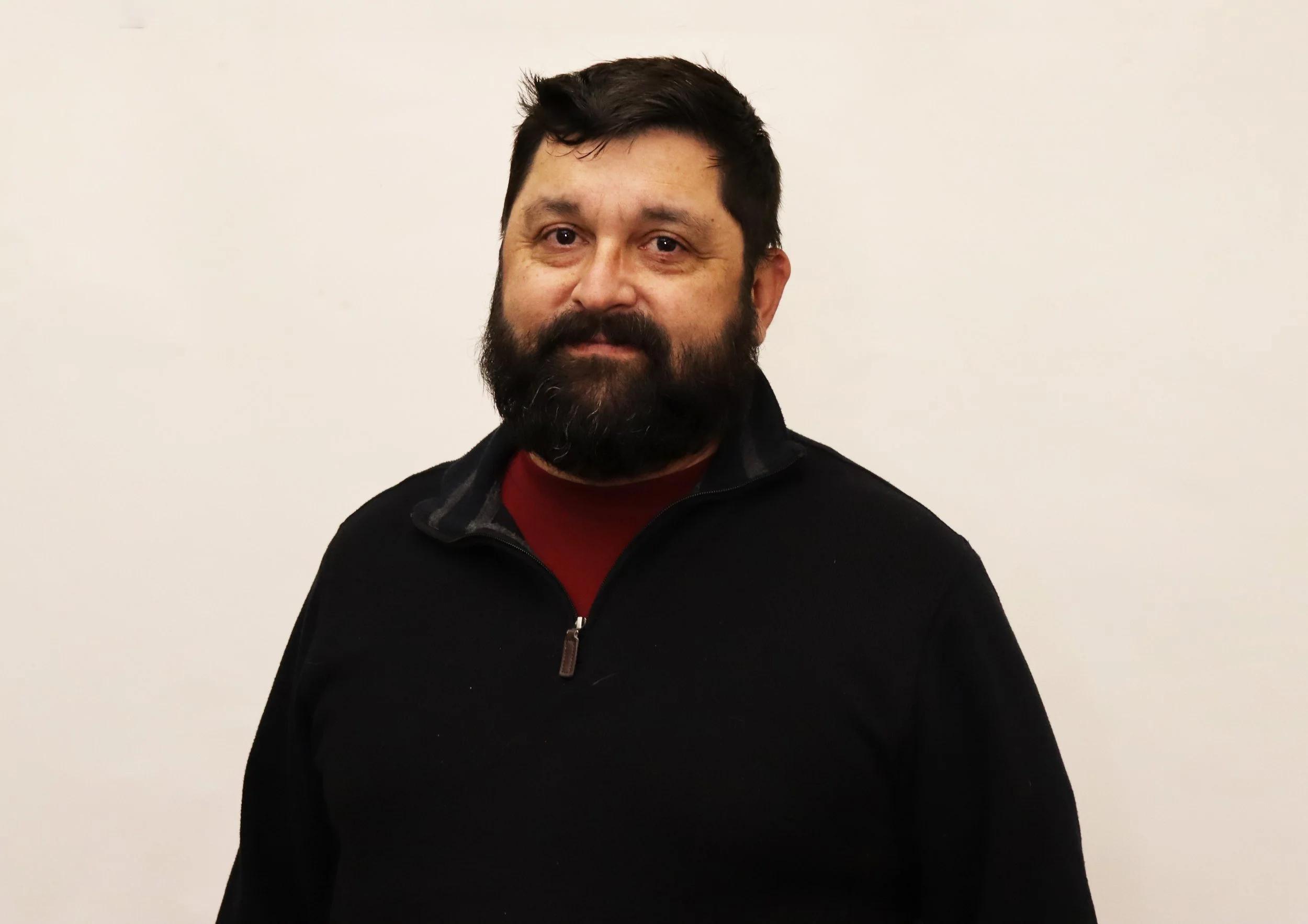
Alejandro Queral (Whitney McPhie)
Spotlight: Alejandro Queral, Executive Director of the Oregon Center for Public Policy
The think-tank leader says concerns about high taxes are overblown.
By OJP Staff
March 30, 2026
Many Oregonians don’t realize it, but this state has a couple of small but influential policy shops quietly trying to shape the debate over taxes and the role of government. On one side is the Cascade Policy Institute, a conservative, libertarian think tank that argues for smaller government and market-driven solutions. On the other is the Oregon Center for Public Policy, where executive director Alejandro Queral and his small team produce a steady stream of research aimed at reshaping Oregon’s economy toward what they describe as “economic justice,” with a particular focus on low-income Oregonians.
Queral, 53, trained as a lawyer and has worked in policy and advocacy in Oregon for nearly 20 years. His nonprofit has pushed for tax credits for the working poor and higher taxes for higher earners. OCPP has long advocated for an end to the tax deductibility of interest on second homes. It also called for Oregon to fully decouple from Trump’s 2025 tax breaks. The Legislature listened to OCCP and others, and did decouple from a portion of Trump’s tax breaks, retaining $300 million over the biennium. (Oregon tax code generally follows federal tax code, meaning filers’ state taxable income is based on their federal taxable income.)
As Gov. Tina Kotek focuses on reelection and her Prosperity Council to reinvigorate Oregon’s economy, Queral tells OJP he’s not sure the governor and her team have properly diagnosed the state’s ills. The interview has been edited for brevity and clarity.
OJP: When people thinking about coming to Oregon look at its high corporate or marginal personal income tax levels, they may not think this state is the best choice. Do you think that’s something for the state to consider?
Alejandro Queral: What we know is that those states that have actually reduced taxes are not performing that much better when it comes to a number of other metrics, including job growth and economic growth. How we frame that analysis is really important, because these tax relief packages that the Prosperity Council may come up with are actually going to mostly benefit the CEOs, the investors of those corporations, and relatively little benefit will accrue to communities and the workers of those companies.
How would you feel if the Prosperity Council’s proposed targeted tax relief?
When we look at the conversation to stimulate economic growth that focuses solely on tax policy, it raises alarm bells. The evidence is that when you cut taxes for corporations, it doesn’t supercharge the economy. It doesn’t supercharge economic growth. And other states that have done so actually don’t rank higher in a number of other metrics, including quality of life, and performance of workers and students.
A lot of the unhappiness we hear is that we’re a fully taxed state, and the services or the results are suboptimal. Do you understand why there’s this revolt against high levels of taxation?
It’s understandable, particularly in the way that those services that we all pay for are deployed and are applied. There’s been a very unequal distribution of those services, whether it’s at the state level or even at specific jurisdictions. I think what would be required of the state is to establish strong accountability systems that allow us to evaluate and assist programs. But the solution here is to make those programs better, to use those resources more efficiently, more effectively, not to reduce the investment that the state is making on those critical pieces of infrastructure that, at the end of the day, are going to make a bigger difference in attracting new businesses to Oregon and in creating a state that is the best place to raise a child, to grow a business, to start a business.
What ails Oregon is a series of decisions that we’ve made, whether it’s giving absolute local control in terms of school decisions and school policies, and how resources are spent, whether it is about mental health and the choices that we’ve made. The state of Oregon provides a number of services, but other jurisdictions provide other services, and that efficiency is not equal across the board.
Can you give us a specific example of this?
There are a number of programs, but Preschool for All in Multnomah County. I think there’s a question about how those resources have been spent. And I think it’s a valid question to ask: Can we spend those resources in a way that is actually going to lead to the outcomes that the program established in the first place?
Do you believe Oregon is collecting enough revenue and collecting it in a progressive way?
It’s clearly not enough. I mean, we’ve been underinvesting in higher education for decades. And so I think you have to look at not the totality of the revenue raised, but is that revenue adequate for the different programs and services that Oregonians need? That question is increasingly urgent in light of the passage of the Republicans’ “One Big Beautiful Bill Act,” which is carving a tremendous budget hole in Oregon for the next decade.I don’t think Oregon’s tax system is progressive enough. I think when you just look at income, it’s mildly progressive. But when you take into account all of the other elements that make up our tax system, at the end of the day, lower-income Oregonians are paying more in total taxes than the highest income earners.
How could you envision politicians, policymakers, asking the public for more revenue when the results of the revenue they’re currently collecting are so poor?
That’s frankly not my problem. I’m not running for elected office. That said, it is a challenging problem. I think part of the solution requires that we establish systems of accountability that demonstrate to the public that their concerns are being addressed. Part of the lack of belief in governments is not just the delivery or efficacy or efficiency of the delivery of those services. It is also the fact that people don’t feel that their needs and concerns are being addressed. For the past 40-plus years, we’ve had trickle-down economics that have led to an increasingly large gap in incomes. The very top continue to get richer while the rest of us are, for the most part, flat in terms of our income. The average Oregonian has not advanced, so that creates a fundamental mistrust in government.