

Tom Fessler is the CEO of Woodburn Nursery & Azaleas, which his parents founded in 1968. (Laura Tesler)
Oregon’s Climate Protection Program Costs Far More Than Other States’—and Is Far Less Accountable
By Nigel Jaquiss
April 1, 2026
WOODBURN — Tom Fessler and his son, Kyle, are trying to do the right thing, but the right thing is about to get a lot more expensive.
Inside Woodburn Nursery & Azaleas’ sprawling greenhouses—they enclose space the size of 94 football fields—the Fesslers recently installed 48 high-efficiency natural gas heaters that cost $6,200 each. It is the latest in a long line of green investments they’ve made, from double-walled, infrared covers for the greenhouses to a robotic potting line.
But in the Willamette Valley, where winter temperatures dictate the survival of the 6 million plants on the nursery’s 620 acres, efficiency only goes so far.
The Fesslers still have to burn natural gas to keep plants alive indoors during the winter. Even with efficiency improvements, burning gas emits carbon into the atmosphere. And now, in Oregon, using natural gas costs more per ton of emissions than anywhere else in the country because of the state’s new Climate Protection Program. The impact of the program started hitting natural gas bills late last year and will hike costs for customers across the state.
After payroll, natural gas is one of the Fesslers’ largest costs—about $120,000 a month during the heating season. Tom Fessler says the state’s new climate policy is a major threat to the business his parents started in 1968.
“It’s horrible,” he says. “My opinion is, allow us to stay in business and we’ll pay our income taxes and our property taxes, because if we go away—we’ve got 300 [employees’] families we’re taking care of right now.”
Critics say the program is a poorly designed job killer.
“The business community always says [climate policy] will put us at a disadvantage,” says Carra Sahler. “They just don’t like being regulated.”
A dozen other states also restrict carbon emissions from natural gas and other fossil fuels. And while Oregon’s program superficially resembles other states’, an OJP analysis, along with interviews of industry and environmental experts, makes clear that Oregon’s program is both uniquely flawed—and uniquely unaccountable. It’s also very expensive.
Industry estimates show over the next 11 years that the penalty for using natural gas in Oregon could reach nearly $5 billion.
“The cost of complying with the CPP is double to triple what it costs anywhere else in the U.S., which places Oregon businesses at an even greater competitive disadvantage,” says Angela Wilhelms, CEO of Oregon Business & Industry. “That means fewer jobs for Oregonians.”
Many of the jobs Wilhelms says are at risk are manufacturing jobs, which typically pay better than service industry work and support additional, related jobs. As Oregon faces escalating federal funding cuts, fewer jobs would erode the state’s ability to provide basic services.
Progressive jurisdictions, such as Canada and Rhode Island, have recently backed away from ambitious carbon-reduction policies amid economic headwinds. Oregon, however, is racing ahead. The state’s determination to proceed with its one-of-a-kind program is generating pushback not only from the business community, but legislators in both parties.
Environmental advocates say criticism of the program is predictable and wrong, reflective of decades-long shortsightedness that kept Oregon, until recently, from capping emissions and levying penalties on those who miss targets.
“The business community always says [climate policy] will put us at a disadvantage,” says Carra Sahler, director of the Green Energy Institute at Lewis & Clark Law School. “They just don’t like being regulated.”
State policymakers have long romanticized Oregon exceptionalism—the pursuit of novel policies. That’s what inspired land use laws that protect the Fesslers and other Willamette Valley farmers. It’s what saved the state’s coastline from developers and what made Oregon the first state to vote entirely by mail. But that same fascination with the untested is also what yielded Measure 110, which decriminalized most hard drugs.
A central question in 2026, as Gov. Tina Kotek places a new focus on Oregon’s economy, is whether the Climate Protection Program will make a material difference in a state that already has among the nation’s lowest emissions per capita or, instead, will push Oregon’s teetering economy off a cliff.
Lawmakers in both parties, including the Oregon Legislature’s senior environmental policymaker, state Sen. Janeen Sollman (D-Hillsboro), think the program is seriously flawed. “I’d like to see more accountability, transparency and flexibility and more ability for the Legislature to direct where the money goes,” Sollman tells OJP. “There is no legislative accountability with the CPP—and that is concerning.”



Woodburn Nursery & Azaleas ships 3 million plants a year, many of them to Costco. (Laura Tesler)
For almost 20 years, Oregon lawmakers tried without success to pass bills aimed at reducing carbon emissions, even amid Democrats’ near-total control of the Capitol. Despite being in the minority in all but one session since 2007, Republicans successfully blocked the bills, a defensive effort that included walkouts and culminated in the populist roar of Timber Unity in 2020, when convoys of angry farmers, loggers and truckers circled the Capitol.
That year, fed up with GOP tactics, then-Gov. Kate Brown issued an executive order creating the Climate Protection Program. Brown’s decree lifted a weighty policy decision out of the hands of the Legislature and empowered a state agency, the Oregon Department of Environmental Quality, to work out the details.
“This executive order is extensive and thorough, taking the boldest actions available to lower greenhouse gas emissions,” Brown said at the time. “As a state, we will pursue every option available under existing law to combat the effects of climate change.”
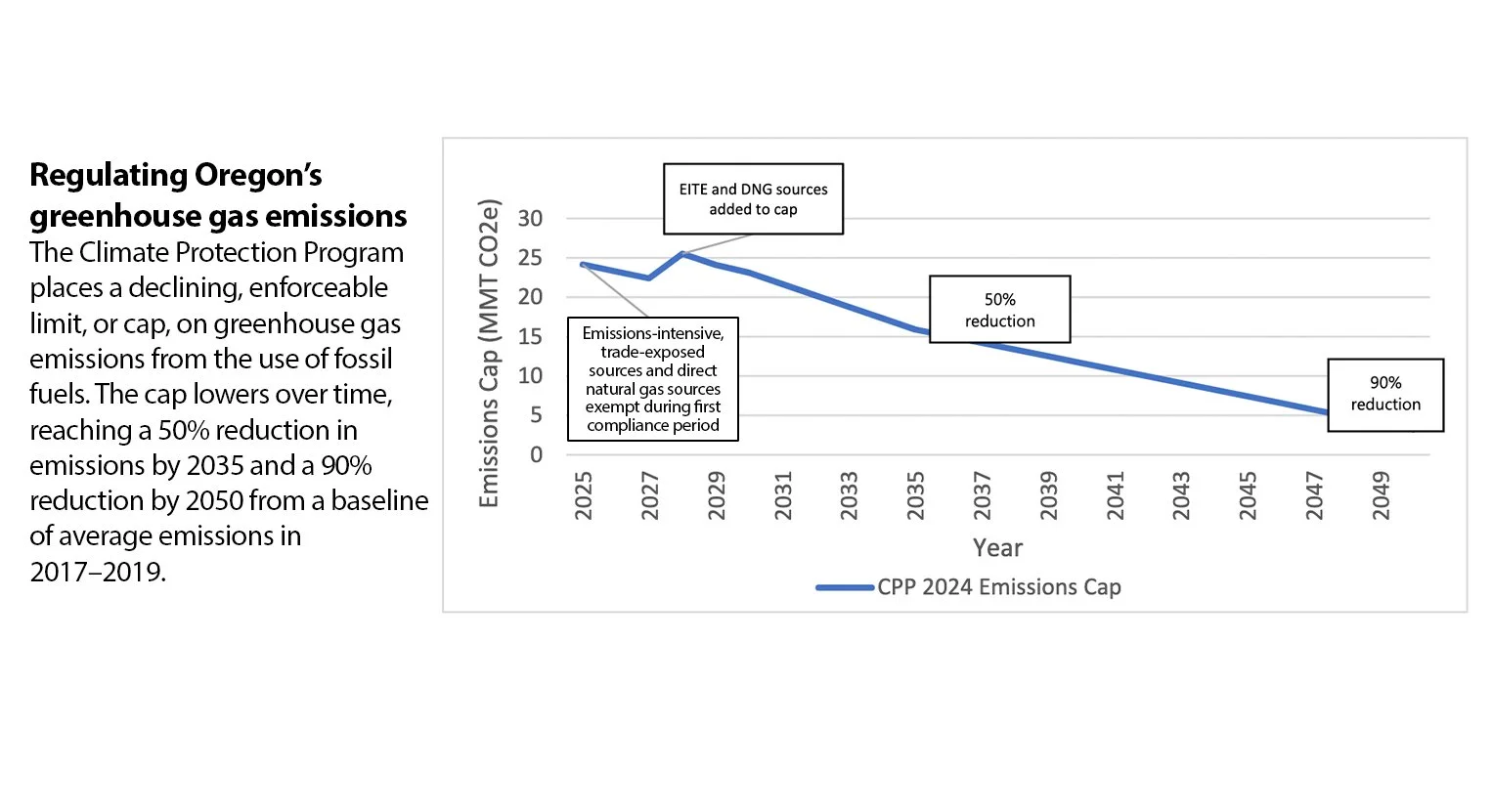
Brown’s order required Oregon to reduce emissions attributable to transportation fuels and “large stationary sources” to 50% below 2017–2019 levels by the year 2035 and 90% below by 2050. Her order applied to wholesale suppliers—such as NW Natural, the state’s largest natural gas company, and dozens of propane, gasoline and diesel fuel importers. (Brown declined to comment.)
Under the CPP, emissions must decline annually (see graph). Users must consume less fuel or switch to cleaner energy sources. If consumers fail to meet the schedule DEQ established, the wholesale suppliers that serve them (NW Natural, Cascade Natural Gas, and Avista in the case of natural gas) must purchase “community compliance investment” credits, effectively paying a penalty, which the suppliers pass on to their customers.
When fully implemented, the CPP will affect those who use transportation fuels and natural gas, from a single-family home with a gas furnace and four-burner stove to the state’s largest industrial companies. Those companies range from nurseries like the Fesslers’ to Oregon food processors, which use natural gas to dry, cook and refrigerate crops; paper mills, which use it to process pulp into paper; and semiconductor manufacturers that use gas for heating, cleaning and backup electricity generation. (DEQ gave 36 of the state’s largest natural gas users extra time to comply. They are exempt from compliance until 2028.)
After a legal challenge, the Climate Protection Program began taking effect last year. To date, transportation fuel (gasoline and diesel) suppliers such as BP, Chevron and Marathon have been able to supply lower-carbon alternatives to comply with the program. Users of natural gas are less fortunate. Current alternatives—such as renewable natural gas made from cow manure or landfill emissions, or hydrogen—are not yet economical.
That means natural gas users must find ways to use less gas or pay a heavy price.
That’s because in 2021, the electric utilities helped shape House Bill 2021, which became 100% Clean Energy for All, a law that was supposed to reduce electric utility emissions. But, in reality, says state Rep. Ken Helm (D-Beaverton), an architect of earlier climate legislation, the law was weak.
“It was a political feel-good Band-Aid that set aspirational goals,” Helm says.
100% Clean Energy for All lacks the hard emissions caps and financial consequences of the CPP. State Rep. Mark Gamba (D-Milwaukie), one of the Legislature’s leading environmentalists, acknowledges that the electric utilities benefited from working their interests in the Capitol while Brown simply dictated the Climate Protection Program.
“That’s why the CPP is actually better,” Gamba maintains. “It didn’t have the opportunity to be gamed, frankly, the way that HB 2021 did by the powers that be.”
Oregon’s program lacks the market approach that drives other states’ emissions reduction programs: Many economists and climate protection experts say a broad, multistate market where fossil fuel consumers can trade emissions allowances offers the greatest efficiency, flexibility and opportunity for innovation. Ten East Coast states hold common carbon allowance auctions; California linked its program with Quebec’s in 2014, and both programs began the process of linking to Washington in 2024.
Oregon’s Climate Protection Program, however, is an island—it does not link to other states’ emissions reduction programs. DEQ’s McConnaha says Oregon’s program is just too different from other states’ programs to sync them together.
“Our understanding is that linkage requires much more harmonization between the programs,” McConnaha says.
"In Oregon, we do a good job of protecting the land." Kyle Fessler says. "But we don’t do a good job of protecting the stewards of the land.”
The CPP money will go to nonprofits: The most politically controversial aspect of the CPP is what happens to the billions of dollars fossil fuel consumers will pay for allowances in the coming years. In other states that have such policies, those resources are funneled into customer rebates and state programs aimed at further reducing emissions—including transportation.
In Oregon, however, those funds do not go to the state, but rather to nonprofits that are supposed to spend the money on emissions reductions “prioritized for Oregon’s environmental justice communities.” DEQ will select one or more nonprofits to administer the CPP money later this year.
DEQ says the money will flow to nonprofits rather than state agencies because the Climate Protection Program originated as an executive order. In other words, because the Legislature didn’t create the program, lawmakers have no say over the money.
Legislators in both parties are uncomfortable with what could be a multibillion-dollar stream of cash that looks like a tax but exists outside their control.
“There ought to be far more legislative oversight and direction to make sure the investments benefit the state as a whole,” says state Rep. John Lively (D-Springfield), who chairs the House Committee on Climate, Energy and Environment. “I think we are missing the mark.”
State Rep. Ed Diehl (R-Stayton), who is running for governor, agrees. “Doing this totally bypasses the ability of the Legislature to hold people accountable for how this money is spent,” Diehl says.
DEQ’s McConnaha says that could change if a majority of lawmakers decide to seize control: “The Legislature could always choose to act in this policy space.”
“The fact that the state has not done a cost impact analysis tells all you need to know about the level of concern policymakers have for such impacts," Bill Gaines says.
Businesses told OJP they could live with the kind of climate reduction program in place in Washington state. Bill Gaines, CEO of the Alliance of Western Energy Consumers, which represents large natural gas users in Oregon, Idaho and Washington, would prefer that Oregon scrap the CPP and copy Washington’s program.
“It’s burdensome,” Gaines says of Washington’s program, “but it is a meaningful improvement over the Oregon program.”
Gaines and others argue that the particulars of Oregon’s program are not only far more costly, they are inflexible and unaccountable to the Legislature and Oregonians who bear the cost.
Here are critics’ chief objections to the CPP:
The cost is high compared with that of other states that have carbon policies: Currently, 12 states enforce emissions reductions by establishing a cost per ton of carbon emitted. When consumers exceed their emissions caps, their fuel suppliers must purchase compliance instruments, also called allowances, at that price. That cost acts as a tax or incentive to reduce emissions. In Washington, the most recent price was $65 a ton; in California, it was $27; and for the 10 East Coast states in the Regional Greenhouse Gas Initiative, $25.
But in Oregon, the state Department of Environmental Quality set the most recent price of carbon at $136 a ton. DEQ says the price approximates its estimated cost of eliminating 1 ton of carbon emissions. That means Oregon businesses that must purchase allowances will pay double, or even five times, what their peers in other states pay.
Colin McConnaha, DEQ’s manager of greenhouse gas programs, says it’s not fair to look at just the difference in the penalty per ton across states. He maintains that Oregon companies will have to buy far fewer carbon credits than companies in other states.
NW Natural disagrees. In all three Western states, the utility says, gas utilities must buy allowances when their emissions exceed the cap—and, NW Natural says, the state’s higher price for carbon hurts Oregon natural gas customers more.
Regardless, it’s unlikely that Oregon businesses can flip a switch that would allow a metal fabrication shop in Ontario or a plywood mill in Grants Pass to quickly meet declining emission targets. Business groups expect their fuel suppliers will have to purchase allowances, amounting to a substantial tax.
How substantial? The Alliance of Western Energy Consumers estimates the cost of the CPP will be more than $4.9 billion over the next 11 years.
DEQ’s McConnaha says his agency has not prepared its own cost estimate: “We’re not really in a role to be estimating or anticipating what each company will do vis-à-vis this program and what their individual compliance strategies will be.”
That doesn’t sit well with big gas users. “The fact that the state has not done a cost impact analysis tells all you need to know about the level of concern policymakers have for such impacts,” AWEC’s Gaines says. “The CPP program appears designed to extract money from energy consumers for redistribution to politically favored groups, all with little or no accountability for climate-related results.”
The prospect of soaring compliance costs worries industrial natural gas users like Doug Puerta, CEO of Stack Metallurgical Group in Portland. Stack uses 70 furnaces to heat-treat parts for companies such as Leatherman Tool, Benchmade Knife, Steelport Knives, and Tube Forgings. Puerta says using heat from electricity (which might actually be generated by a utility burning natural gas) costs about four times more than natural gas—and gas furnaces last much longer.
“The biggest threat is to our customers,” Puerta says. “My costs go up and I pass that along to them. The risk is, they relocate to other states or countries.”
The CPP enforces a double standard: Oregon’s Climate Protection Program does not include the state’s single biggest consumer of natural gas: electric utilities that burn natural gas to generate electricity (see graph). In California and Washington, investor-owned utilities that burn natural gas to generate electricity are subject to the same emissions reduction program as other natural gas users. In Oregon, however, electric utilities like Portland General Electric, PacifiCorp, and Idaho Power are not regulated by the Climate Protection Program.
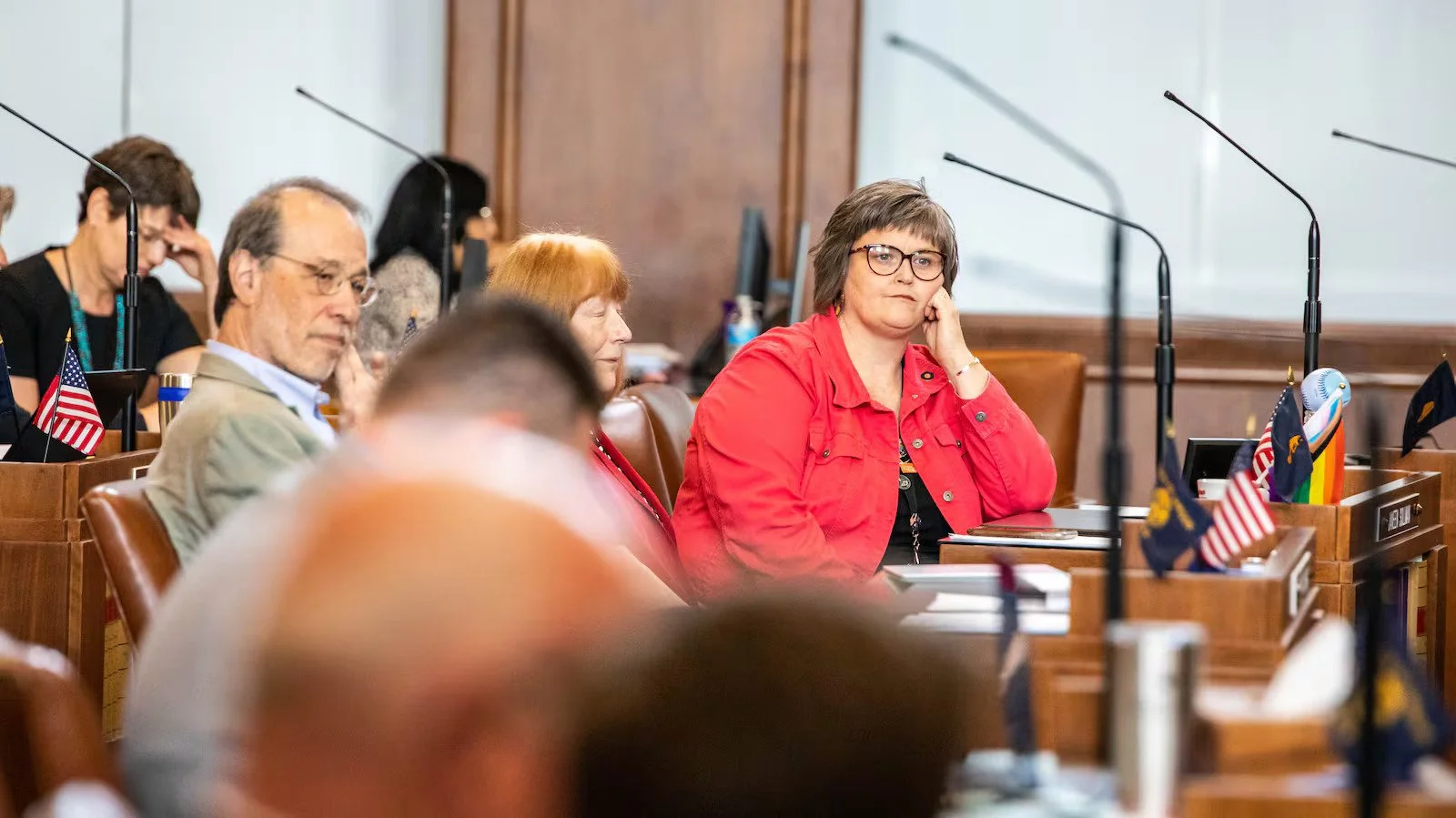
State Sen. Janeen Sollman (D-Hillsboro) chairs the Senate Energy and Environment Committee. (Blake Benard)
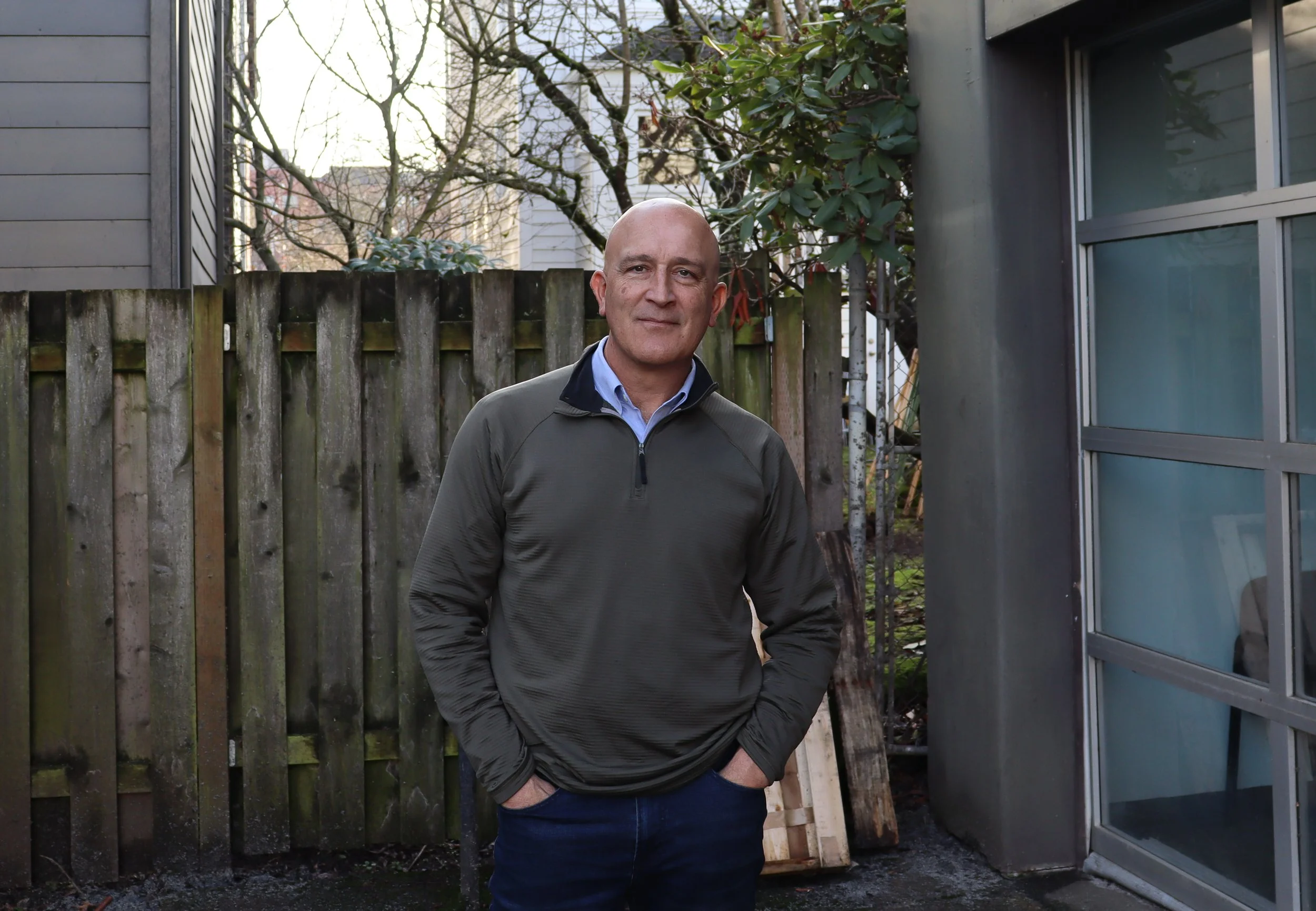
Senate Minority Leader Bruce Starr (R-Dundee) wants changes to the Climate Protection Program. (Sophia Mick)
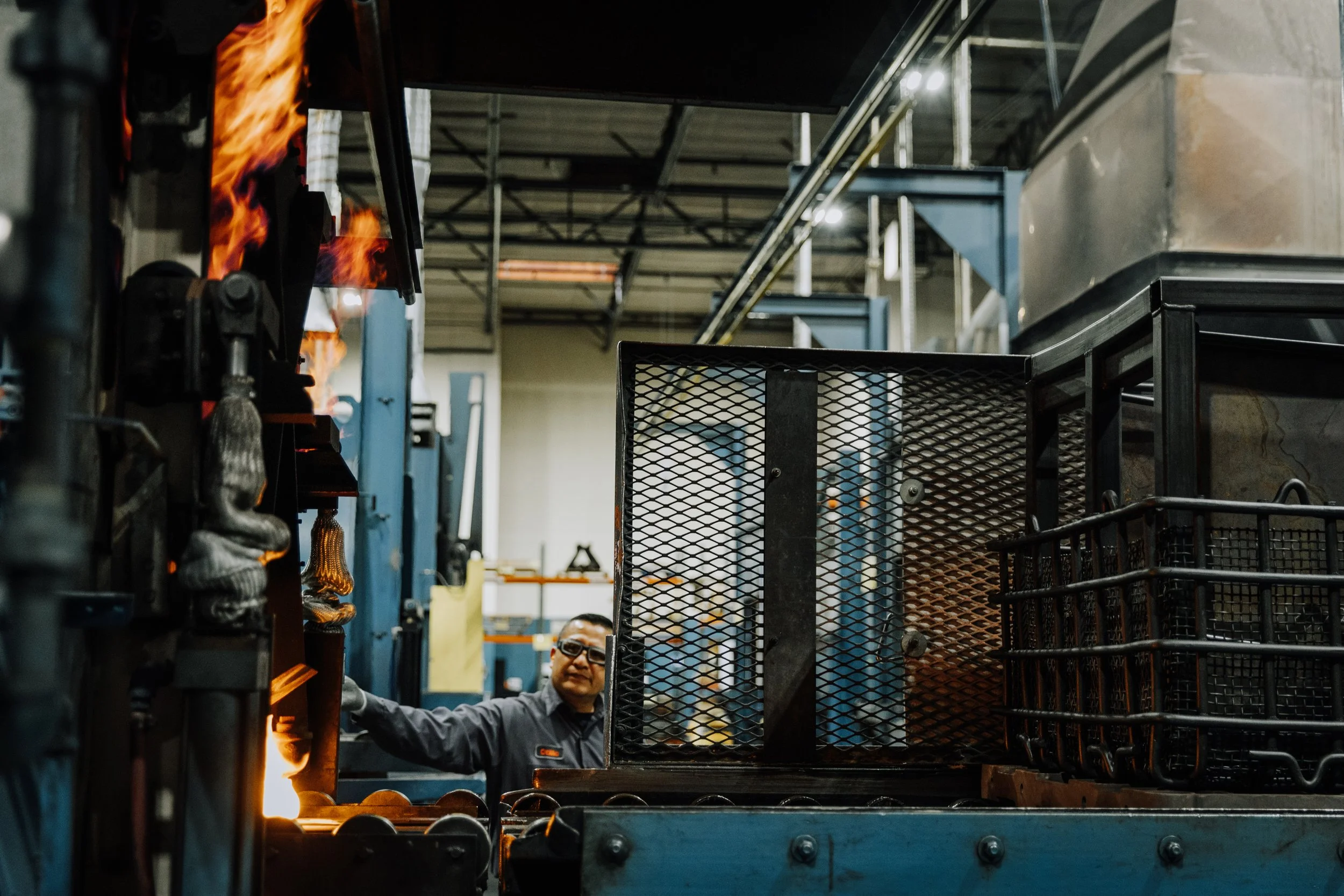
An employee at Stack Metallurgical Group in North Portland checks one of the company’s 70 furnaces. (Courtesy of Stack Metallurgical Group)

Kyle Fessler (left) works with his father, Tom, and other family to run the nursery. (Laura Tesler)
Legislators, including Sollman and Senate Minority Leader Bruce Starr (R-Dundee), started talking about overhauling the Climate Protection Program during the 2025 legislative session and replacing it with a program more like those in adjoining states.
Starr raised the idea as lawmakers sought to fund the ailing Oregon Department of Transportation. He suggested if there was going to be a carbon tax, some of the proceeds could go to ODOT, since some of it would come from transportation fuels. The push for change failed.
Starr worries that his legislative colleagues are asleep at the wheel. "I think we have to make significant changes if we are going to have any large-scale manufacturing left here," Starr says. "You sure as hell are not going to attract new industry to Oregon without them.”
Sollman says Oregon could learn from neighboring states.
“The big thing California and Washington have in their programs is stability,” Sollman adds. “Gov. Kotek said Oregon is open for business. Well, to me that means stability and consistency.”
Kotek, of course, could simply rescind or alter her predecessor’s executive order, but has given no indication she plans to do that.
“The governor remains firmly committed to the original intent of the CPP,” says Kotek spokesman Luke Harkins, who adds that the governor “believes we can fight climate change while also bolstering economic opportunities in Oregon.”
Nora Apter, Oregon director of the nonprofit Climate Solutions, says there is no need for legislative tinkering. Her view is that the CPP represents a thoughtful framework that holds the potential for new green jobs and offers fossil fuel consumers predictability. Halting the program or making substantial changes, Apter says, could cause chaos.
“We always hear that regulatory certainty is important to industry,” Apter says, “but what we’re getting is constant pushback.”
For the Fesslers, if the regulatory cost of heating their greenhouses with natural gas outpaces the value of the plants inside, the third generation to run the nursery might be the last. Tom Fessler, 63, says he can imagine being forced to shut down the indoor operation—a move that would scrap millions in investment and could put many of the company’s 300 employees out of work.
“When you talk about natural gas—all this covered space we have where we can grow higher-value crops inside—we may not have the ability to grow those high-value crops anymore,” Tom Fessler says.
“In Oregon, we do a good job of protecting the land,” his son, Kyle, adds. “But we don’t do a good job of protecting the stewards of the land.”