
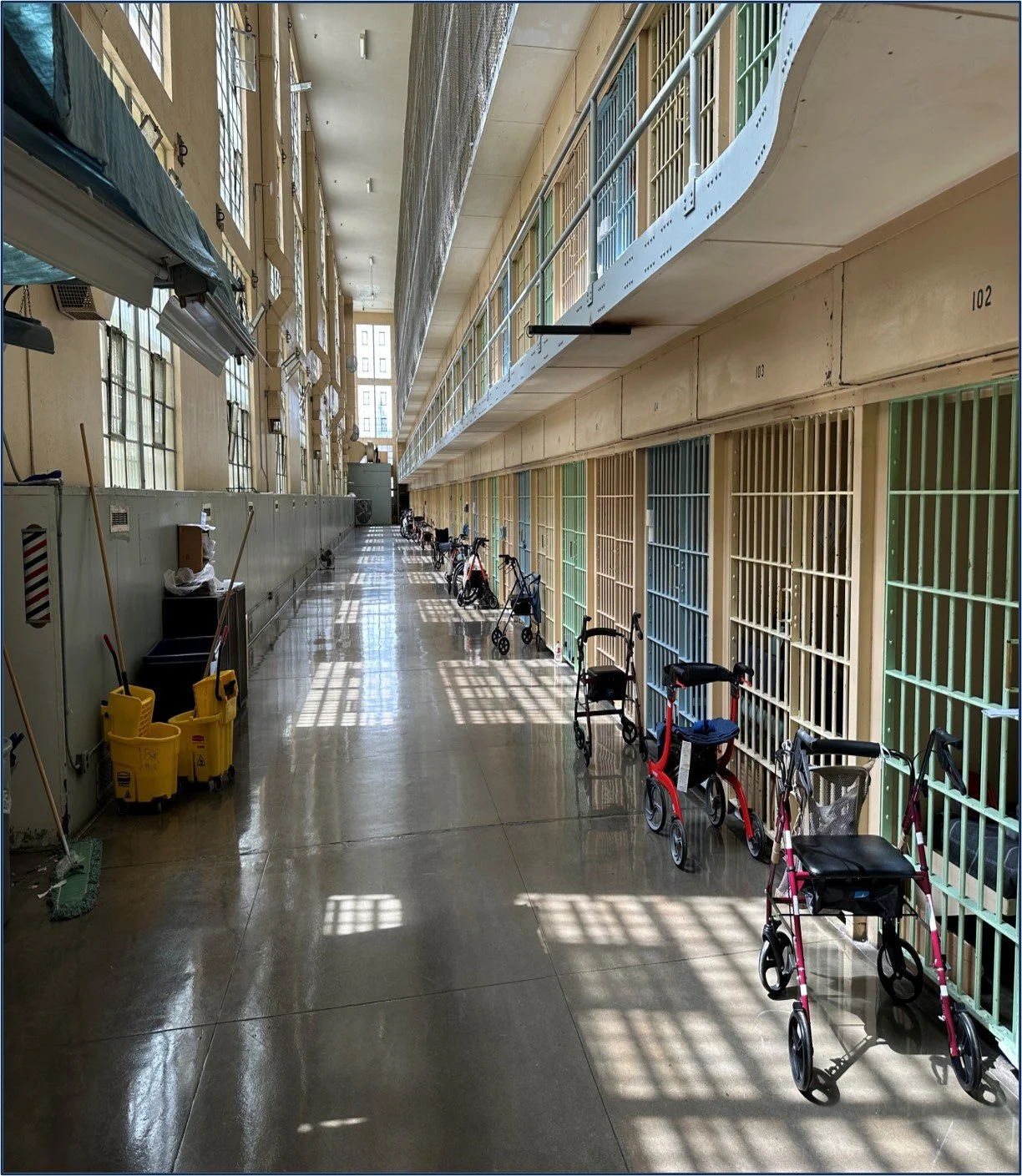
An aging prison population is one driver of the poor financial health of Oregon’s state insurance fund (Courtesy of Oregon Department of Corrections)
Massive Prison Payout Highlights Dismal Financial Picture for State Insurance Fund
Escalating liabilities soar faster than lawmakers appropriate money to pay settlements.
By Nigel Jaquiss
July 8, 2026
Last month, Oregon agreed to pay $49 million to COVID-afflicted state prison inmates. It’s the state’s biggest payout ever—and underscores an underlying liability that is far larger.
The estates of 38 inmates who died are set to receive $33.1 million; $15.9 million will go to 5,000 inmates who contracted the virus while in custody.
Although Oregon took extraordinary measures to protect the general public during the pandemic, lawyers argued in a federal class action lawsuit originally filed in 2020 that the state Department of Corrections failed to follow U.S. Centers for Disease Control and Prevention guidelines for people living in congregate settings, resulting in the third-highest rate of infection among state prison inmates nationally.
The inmates and their families will now have to wait a bit longer for their money: All but $10 million of the settlement needs approval by the 2027 Legislature.
That’s because the insurance fund the state manages to pay for liabilities is badly under-financed.
At the end of fiscal 2025, records show, that fund (which is administered by the Oregon Department of Administrative Services and is unrelated to the non-profit State Accident Insurance Fund) held assets of just $16 million, while it faced liabilities totaling $426 million.
In other words, the fund owes vastly more money than it has the ability to pay and is effectively broke.
Rather than purchasing commercial insurance to cover all of its liabilities, the state “self-insures” against some of them, setting aside money from operating budgets each year in a separate fund (it also purchases commercial insurance for workers’ compensation and for damage to the state’s $11 billion in property).
Many governments and large companies such as Nike and Intel are self-insured—the practice can save money. Oregon law calls for the state’s self-insurance fund to be “actuarially sound”—i.e., contain at least enough money to cover 70% of liabilities.
But since at least 2019, the Legislature and the governor have failed to set aside enough money to hit that mark, despite robust budgets. And things have gotten dramatically worse.
“It’s nuts,” said state Sen. Kate Lieber (D-Portland), co-chair of the Joint Ways and Means Committee, which writes the state’s budget.
Lieber said lawmakers actually allocated slightly more than Gov. Tina Kotek requested in her 2025 budget, but it wasn’t nearly enough to begin rebuilding the fund.
The state used to be more prudent. Through 2015, records show, assets typically equaled liabilities. As recently as 2019, the insurance fund held assets equal to about two-thirds of anticipated liabilities (each state agency pays an annual assessment to DAS, which invests the proceeds with the Oregon State Treasury).
Kotek warned lawmakers prior to the 2021 session that the situation was dire, noting in her budget message, “A major increase in risk charges from the 2023–25 level is needed to prevent the assets declining to zero, bankrupting the fund.” But a slight bump in funding didn’t make much difference.
Unlike other state liabilities, such as the Public Employees Retirement System (about $29 billion in the red), or major assets, such as the Rainy Day Fund (about $2 billion) and Education Stability Fund (about $1 billion), the state’s self-insurance fund is neither particularly transparent nor well understood by many lawmakers.
In 2025, state Sen. Sara Gelser Blouin (D-Corvallis), Sen. Suzanne Weber (R-Tillamook) and Rep. Werner Reschke (R-Malin) sponsored Senate Bill 463, which requires DAS to publish an annual accounting of the insurance fund annually. The first report, filed in January, makes for dismal reading.
“The high-level reasons for the worsening health of the Insurance Fund are twofold,” the report said. “First, the Insurance Fund has not been funded at levels recommended by independent actuaries…the second reason for worsening health is a dramatic increase in payouts.”
The narrative of those payouts includes some eye-popping details: During the previous two years, the state paid out 37 claims of over $1 million each, nearly all for general liability. Total payouts jumped from $134 million in the 2019–21 biennium to $330 million in 2023–25, a 146% increase.
The Department of Corrections, which houses 12,000 inmates, pays the largest assessment to the insurance fund, an indication of the large number of claims it faces.
Agency spokeswoman Amber Campbell attributed growing liability costs to an inmate population that has grown older and less healthy. “These trends have contributed to an increase in complaints and, in some instances, litigation and settlements,” Campbell said.
The Department of Corrections’ assessment for the insurance fund increased from $38.9 million in 2023–25 to $92.3 million in the current budget cycle—a 137% increase.
In effect, the soaring liability costs act as a hidden tax on services, reducing the amount of money agencies have to spend on other things.
DAS spokeswoman Bryanna Duke attributes the skyrocketing payouts to a number of factors: more claims and lawsuits; higher medical expenses; higher liability caps (which increase with inflation); and the growing number of cases filed in federal court, which are not subject to caps. And, of course, COVID, which contributed not only to the record Department of Corrections settlement but to an explosion in workers’ comp cases.
Sen. Gelser Blouin said the escalating costs raise questions about policies and training, particularly at the Departments of Corrections and Human Services, which incur the biggest liabilities.
“One of the reasons I was interested in more disclosure and more real-time information is that it typically highlights some kind of failure at an agency and highlights the risks and the costs of how they are operating,” Gelser Blouin said.
Kotek spokesman Luke Harkins said the governor remains concerned about the fund’s finances.
“The governor takes the stability of the risk fund seriously,” Harkins said. “Oregonians deserve a government that is both responsive and fiscally prudent.”
But state Sen. Christine Drazan (R-Canby), Kotek’s November opponent, said Kotek should have pushed harder to bolster the fund. Drazan said the record settlement points to a need for more accountability.
“Government can’t prevent every lawsuit, but it can do a much better job preventing costly mistakes,” Drazan told OJP. “Oregonians are tired of paying for government’s failures. Every dollar spent on avoidable lawsuits is a dollar we can’t spend on safer communities, better schools, or helping the people who truly need it.”