
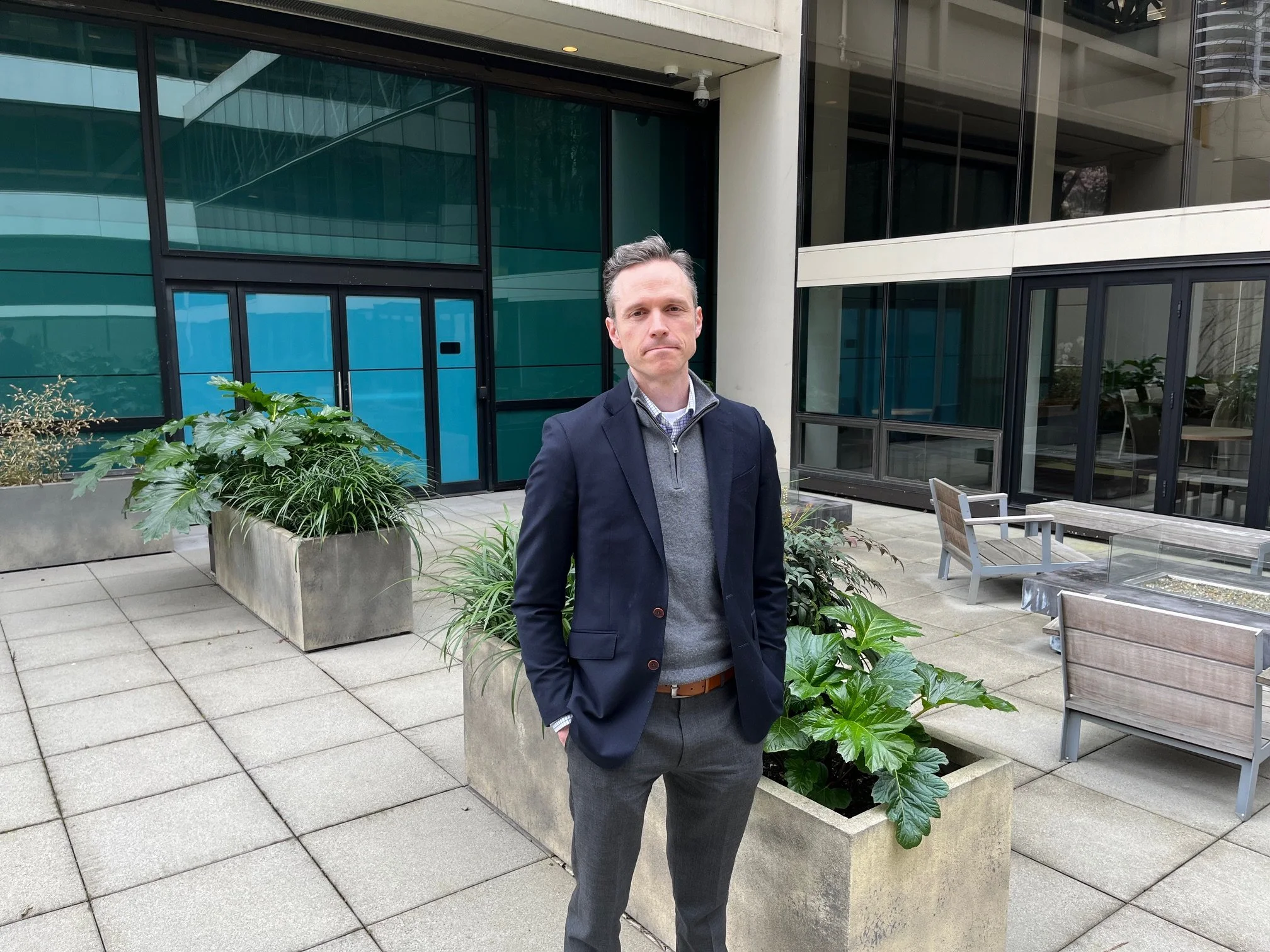
Scott Kennedy is one of 12 former federal lawyers to recently defect to the Oregon Department of Justice. (Courtesy of Scott Kennedy)
Lawyers Flee Donald Trump’s Department of Justice in Oregon and Across the Country
A widespread exodus from federal law enforcement is a mixed blessing for Oregon.
By Jeff Manning
March 20, 2026
After five fulfilling years working for the U.S. Department of Justice, it took just five months under President Donald Trump for Portlander Scott Kennedy to decide he couldn’t stay.
Like thousands of other Department of Justice lawyers, Kennedy came to the conclusion he couldn’t work for Trump or his Attorney General Pam Bondi.
“There was fear brewing,” Kennedy tells OJP. “Fear about the uncertainty, fear that they’d lose their jobs, and for me, there was fear that I’d be ordered to defend something that was indefensible.”
Trump’s impact on the U.S. Department of Justice has ripped through Oregon like a Tomahawk missile. The U.S. Attorney’s Office in Portland has suffered a significant number of defections. Filling those positions has proven difficult, raising concerns about a “brain drain” at the regional office that could have an impact on public safety. The impact goes far beyond Portland. The U.S. Attorney for the District of Oregon has satellite offices in Eugene and Medford, both of which have also recently lost attorneys.
The federal government’s losses, however, have been the state’s gain. Over the past year, the Oregon Department of Justice has hired 12 former feds, including Kennedy.
It’s hard to overstate the significance of the defections from U.S. attorney’s offices. Federal prosecutors are the tip of the spear of federal law enforcement. They investigate and prosecute some of the most difficult cases—high-level drug trafficking, tax evasion, sophisticated financial crimes, hate crimes, and complex environmental violations, among others. The office is also expected to represent the U.S. government in civil cases and collect money owed to the government.
Christopher Parosa, Lane County district attorney, worries about the impact of a downsized federal prosecutors office. Last year, the U.S. Attorney's Office in Oregon partnered with Lane County law enforcement to take down a burglary ring of South American nationals.
“Any time you lose experienced prosecutors, the whole system suffers,” Parosa says. “It makes the community less safe.”
Kennedy, 42, grew up in the Overlook neighborhood of North Portland and loved his job working consumer protection cases for the U.S. Department of Justice in Washington, D.C.
“The people were brilliant and the work was important,” Kennedy says of his time inside the Beltway. “It was a very rewarding experience.”
But that all began to change last January after Trump took office last year for the second time. He summarily called off investigations, fired prosecutors, and pardoned criminals who’d already been put away by the Department of Justice.
Trump has issued some 1,800 pardons and commutations in his second term, none more controversial than the blanket clemency he offered to the Jan. 6 mob that stormed the Capitol and ransacked it in hopes of disrupting the 2020 vote certification. It was a disheartening move for the Oregon offices. Several local Department of Justice lawyers helped develop an evidence filtering technology that proved instrumental in the prosecution.
Other Trump pardons also hit close to home.
In 2020, at the end of his first term, Trump commuted the sentence of Jon Harder, the former Oregon CEO of Sunwest Management. When Trump freed him, Harder was five years into a 15-year sentence for the crime of misleading 1,400 investors about the true financial condition of the assisted living centers his company managed, resulting in $120 million in losses.
Even more infamous was Andy Wiederhorn, the onetime Portland whiz kid who in 2004 was sentenced to 18 months in federal prison for his involvement in what at the time was the largest labor pension fund scandal in U.S. history. He served about 14 months in federal prison in Sheridan, Ore.
In 2024, he was again indicted by the federal government, this time for allegedly using one of his companies as a “personal slush fund,” the Justice Department said.
The case collapsed after the lead prosecutor was informed by the White House that he was being fired. Years earlier, that prosecutor had criticized Trump during an unsuccessful bid for Congress.
Several months later, the Justice Department said it was dropping the case against Wiederhorn.
“You can certainly add that to the list of Trump actions that are indefensible,” says Kent Robinson, a longtime federal prosecutor in Portland who worked in the U.S. Attorney’s Office during the Wiederhorn investigation.
On Feb. 5, 2025, U.S. Attorney General Pam Bondi issued a memo to all DOJ employees clarifying their priorities. In addition to enforcing criminal and civil laws, department lawyers were also charged with “vigorously defending presidential policies and actions against legal challenges,” the memo stated.
For an agency that has built a reputation as an independent, apolitical body, the message for some seemed clear—time to go.
In January, Reuters reported that more than 2,500 of the DOJ’s 10,000 lawyers had retired or quit since Trump took office.
The exodus hit home in the Oregon U.S. attorney’s offices in Portland, Eugene and Medford. According to an analysis of data by the U.S. Office of Personnel Management, there were 38 “separations” in Oregon from the Justice Department in 2025. Separations include resignations, layoffs, terminations and retirements.
According to its website, the U.S. attorney’s offices in Oregon have107 employees. About half are lawyers.
Scott Bradford, the veteran prosecutor who now serves as U.S. attorney in Oregon, declined interview requests and would not confirm or deny the personnel departures.
Billy Williams, U.S. attorney in Oregon from 2015 to 2021, says Bradford’s desire to keep a low profile is understandable. “You can’t take that job under this administration and not fear that you could be fired,” Williams says. “Things are very politicized. I just wish that both sides would step back and take a breath.”
The current turmoil marks a significant change from previous years. “Portland was known as a lifer’s office, people just didn’t leave,” says Williams, the former U.S. attorney. “Any time we did have an opening, there would be hundreds of applicants. It concerns me, the brain drain that is going on.”
Whitney Boise, a veteran defense lawyer in Portland, echoed Williams’ concerns. “It’s just kind of shocking that so many have left,” Boise says. “It’s very disturbing because so much of the institutional knowledge has been lost.”
The good news, perhaps, is that the Oregon Department of Justice confirms it has since hired 12 of the departed feds. Thanks to the state Legislature, Oregon Attorney General Dan Rayfield had additional funds to spend on more lawyers.
Rayfield says he’s eager for his Justice Department to fill the roles once staffed by federal prosecutors. “There’s all this great talent on the market; it’s like an embarrassment of riches,” he says.
OJP reached out to the Department of Justice in Washington. The department declined interview requests, but did issue this statement: “After four years of bureaucratic weaponization under the Biden administration, President Trump and Attorney General Bondi have created the most efficient Department of Justice in American history equipped with attorneys who are committed to delivering measurable results for the American people.”
Kennedy left the federal Department of Justice in May of last year, and a month later he had joined the state Department of Justice. To his own lasting delight, he now represents Oregon in multiple cases against the Trump administration and his former employer, the federal Department of Justice.
He was the state’s lead counsel in its successful bid early last November to block Trump from nationalizing the Oregon National Guard for use in the ICE protests. After a federal judge sided with the state, the Trump administration dropped its effort.
Kennedy is now doing the kinds of cases to which he always aspired—just in a different city and for a different Department of Justice, he says. “It’s a rare opportunity for an attorney to keep an aspect of our democracy working.”