
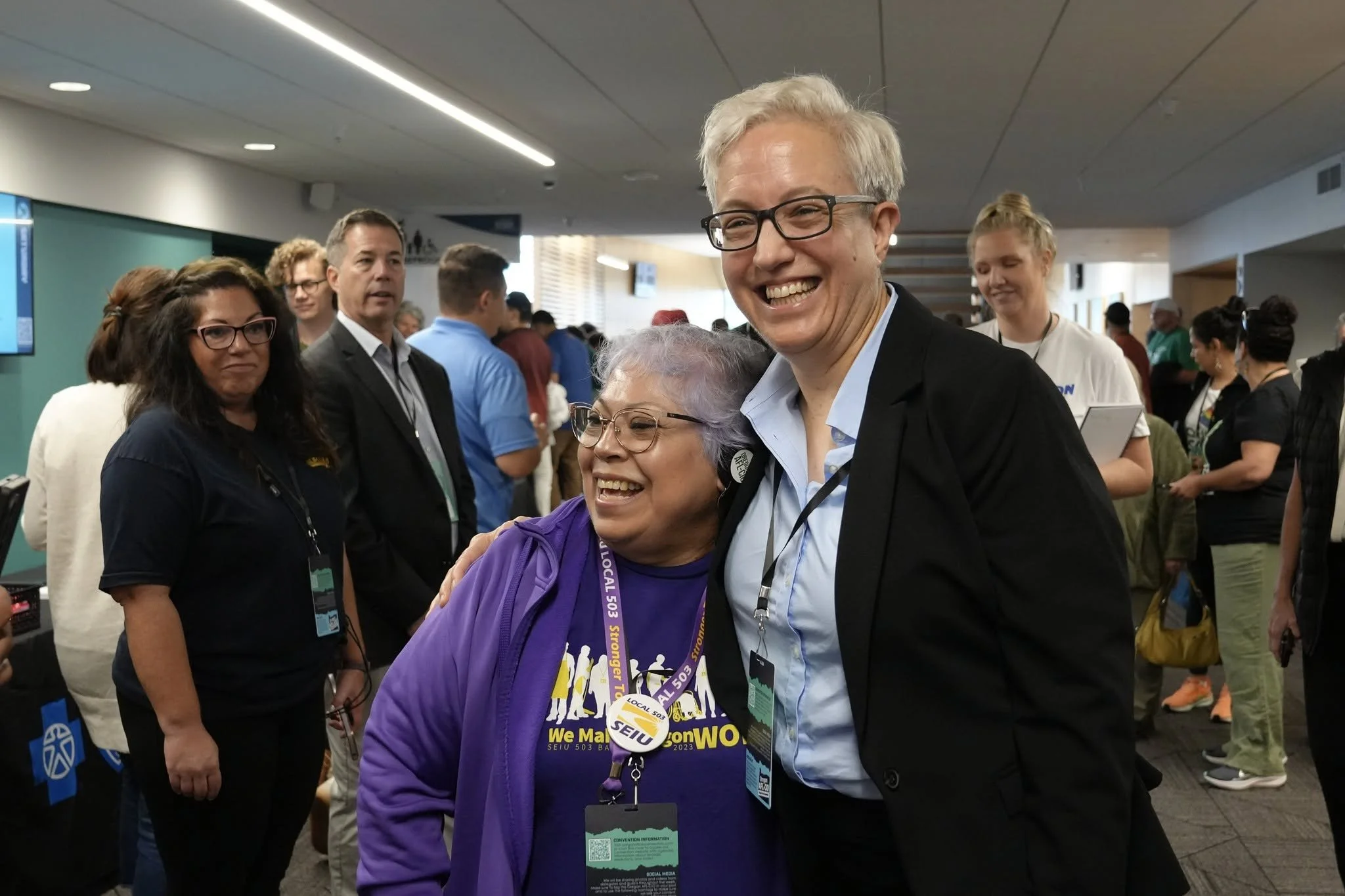
Gov. Tina Kotek joined union members at a September 2025 labor gathering in Seaside (Courtesy of Gov. Tina Kotek)
Judge Rules Against SEIU in Bid for Background Information
The skirmish is the latest round in a battle over union membership.
By Nigel Jaquiss
August 26, 2026
For 10 months, Service Employees International Union Local 503 has been trying to obtain names and other information about 70,000 Oregonians who applied for state background checks to work as caregivers.
As OJP has reported, the union hoped to contact the applicants and potentially enlarge SEIU’s membership.
But earlier this month, a Marion County circuit judge blocked the union’s access to those names. The permanent injunction marks another round in a high-stakes public records battle involving the state’s largest and most powerful public employee union.
Last November, SEIU filed a public records request with the Oregon Department of Human Services for the names, phone numbers and other identifying information for people who requested background checks from the agency. (DHS background checks are a required step for people seeking to work with seniors and those with certain disabilities.)
SEIU currently represents more than 87,000 workers in Oregon and plays an outsized role in Oregon politics: Its two political action committees contribute about $3 million in election years, nearly all of it to Democratic candidates and causes.
Although the union represents government and university employees, the largest part of its membership—more than 30,000 workers—consists of home health care workers who do not work for state or local government.
While some caregivers are members of SEIU, tens of thousands of workers who provide services to seniors and adults with disabilities are not. As the state’s population ages, those workers are a tempting target for SEIU. The union’s pursuit of those workers fits into a larger battle.
For at least a decade, Oregon’s public employee unions and anti-union groups, led by the Freedom Foundation, have fought over access to the names of current or, in this case, prospective employees. The unions want to increase membership while the Freedom Foundation wants to reduce unions’ power by persuading members to opt out of membership.
After sitting on SEIU’s public records request for four months, DHS told caregivers March 12 that it would release the requested names the next day. The news caught the Oregon Health Care Association (which represents about 1,000 senior care facilities) and other adult care providers by surprise. They asked DHS not to release the records, which prompted a temporary pause.
In May, the provider groups filed suit in Marion County Circuit Court to block the release. The provider groups argued “disclosure of the workers’ information would expose private individuals to potential identity-related risk, employment-related harm, and safety-related harm.”
Judge Thomas Hart probed SEIU’s motivation for seeking the names. “503 wants to use this for union activities, right?” Hart asked SEIU’s attorney, Margaret Olney.
“Certainly,” Olney replied.
At an Aug. 13 summary judgment hearing, SEIU and the Oregon Department of Justice, which represented DHS, argued the names of background-check applicants should be a public record.
The trade associations argued the information was submitted in confidence and was covered by an existing exemption from disclosure under Oregon Public Records Law.
In the course of an hourlong hearing, Judge Thomas Hart probed SEIU’s motivation for seeking the names. “503 wants to use this for union activities, right?” Hart asked SEIU’s attorney, Margaret Olney.
“Certainly,” Olney replied.
Hart granted the permanent injunction, meaning SEIU may not have the records.
Felisa Hagins, executive director of SEIU Oregon State Council, said her union found Hart’s decision “disappointing” and is mulling an appeal.
Earlier, SEIU was unhappy that DHS took so long to respond to the request the union filed in November (the law requires agencies to respond within 20 days or, in the case of complex requests, “without unreasonable delay.”)
It’s not clear what role Gov. Tina Kotek played in the drama.
Hagins told OJP that SEIU contacted Kotek’s office in January to express frustration that DHS was taking so long to respond to its record request. The union told the governor’s office it was prepared to file a lawsuit to obtain the 70,000 names, which is the avenue the public records law provides for noncompliance.
“I firmly believe that before we sue the state we need to call the governor’s office,” Hagins told OJP.
Kotek is a longtime SEIU ally. The union gave her more than $2 million for her 2022 election campaign and has contributed $550,000 so far this year for her reelection bid.
Still, DHS told SEIU that it could not act on the request until after the legislative session, which ended March 6. Shortly after the session, DHS told the union it would in fact give it the records. That triggered the legal scramble by care providers to block release.
Hagins said SEIU’s relationship with the governor was not a factor in the records dispute.
“We’ve written multiple public reports about abuse, fraud and the working conditions of these caregivers,” Hagins said. “I hope that would give us some standing.”
Asked about the governor’s office’s communication with DHS about SEIU’s request, Kotek press secretary Hazel Tylinski said only, “The governor’s office regularly interfaces with agencies as they work to follow the law.”
When DHS decided to release the records and the trade associations sued to block the release of the names, Kotek’s office stayed neutral, Tylinski said.
“While [the lawsuit] was pending, the governor’s office directed the agency to adhere to legal guidance and not release the records until further order of the court,” she said. “The governor’s office was otherwise not involved in the lawsuit."
A leader of the largest provider group applauded Judge Hart’s decision to deny SEIU the records.
“We are pleased with the judge’s ruling and that the privacy interests of caregivers were rightfully protected,” said Phil Bentley, CEO of the Oregon Health Care Association, echoing the response of the leaders of other caregiver associations.