
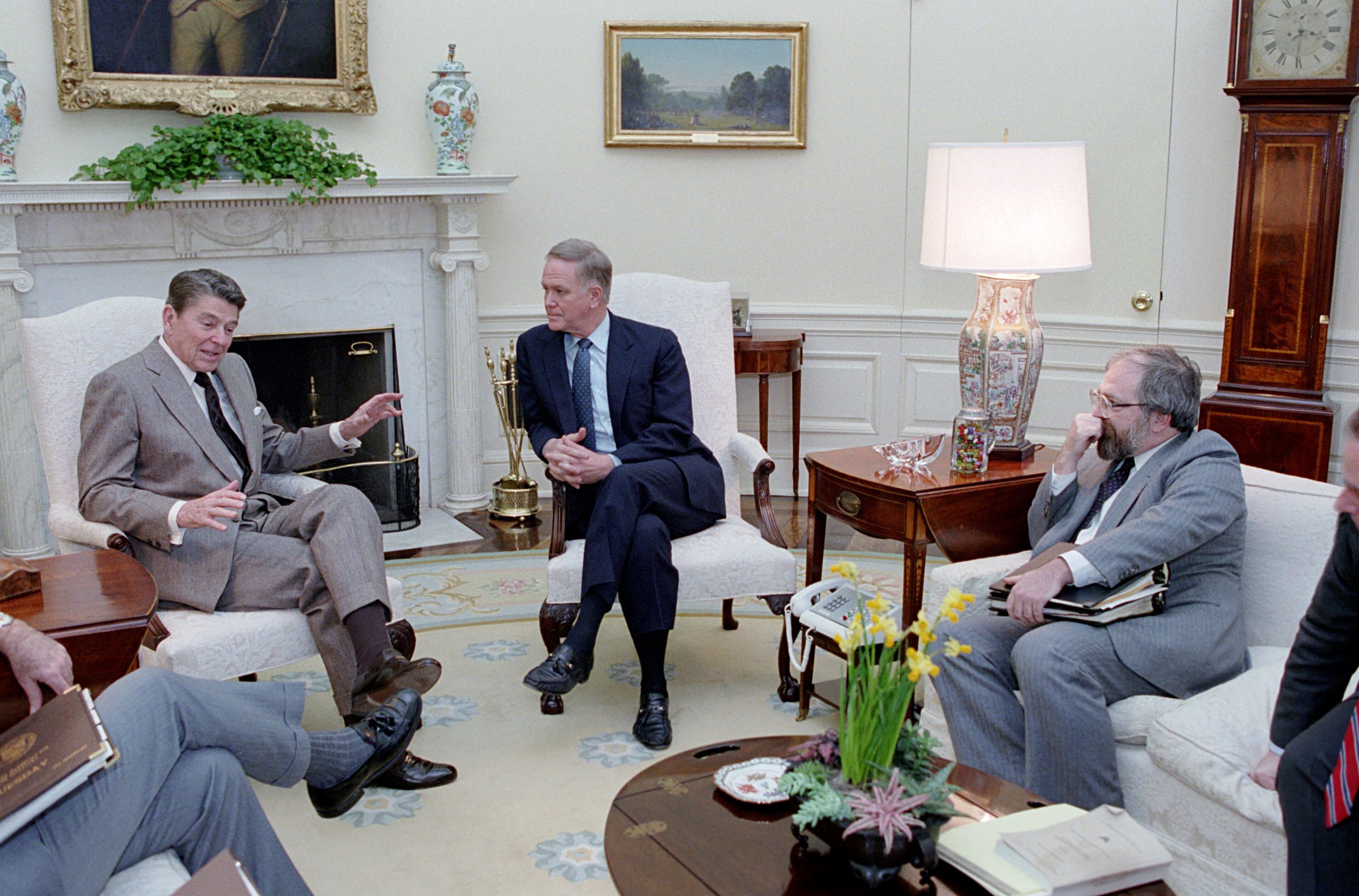
U.S. Sen. Bob Packwood in the Oval Office with President Reagan in 1986 when he was at the height of his influence as chairman of the Senate Finance Committee (Wikimedia Commons).

Former U.S. Senator Bob Packwood Dies at 93
The Senate’s master of the tax code will instead be remembered for the scandal that ended his career.
By Steve Duin - stephen.b.duin@gmail.com
June 6, 2026
Bob Packwood was an awkward and epic contradiction, a champion of political compromise with a fatally compromised personal life.
He died June 6 in a care facility of natural causes at age 93, according to a family spokesperson, 31 years after the Select Committee on Ethics voted unanimously to expel him from the great love of his life, the United States Senate.
When Packwood, a Republican lawyer from Portland, arrived on Capitol Hill in 1969 after narrowly defeating Oregon Democratic incumbent Wayne Morse, he became, at 36, the youngest member of what was then known as the “world’s greatest deliberative body.”
Over the next quarter century, he gained extraordinary power and influence in that chamber, eventually taking charge of the Senate Finance Committee and championing the 1986 Tax Reform Act.
Packwood also gave women high-paying roles on his staff and his reelection campaigns. As Gary McMurray, his former Portland law partner, told the Los Angeles Times, he championed women’s issues “because he believed women are the guardians of liberty, but they are never given any.”
All the while, Packwood, who married Georgie Ann Oberteuffer in 1964, was romancing or assaulting many of the women who crossed his path. He would later claim in his voluminous diaries—which he made public in hopes of staving off political exile—that there were “22 staff members I’d made love to and 75 others I’d had a passionate relationship with.”stephen.b.duin@gmail.com
“...He found out when he was elected that all of a sudden he had power over women. He liked that. Bob Packwood was all about power.” - Julie Williamson
Many were young women who, in later testimony before the Ethics Committee, described terrifying encounters with Packwood in which he kissed or pounced on them in his office or the Capitol basement.
“I came to the conclusion that all you had to be was a female alone in the room with him,” said Julie Williamson, who claimed Packwood kissed the back of her neck in 1969 when he found her working alone in his Portland office, then backed her into a corner, grabbing her ponytail with one hand and clawing for her girdle with the other.
When Williamson quit two weeks later, she asked Packwood if he seriously thought she would submit to him on the office rug. He responded, memorably, “I suppose you’re one of the ones who want a hotel room.”
“A lot of men want respect from powerful men more than they want that from women,” Williamson once told me. “He liked conquering women. I’d known him for years, and he was always kind of a nerd. But he found out when he was elected that all of a sudden he had power over women. He liked that. Bob Packwood was all about power.”
Robert William Packwood was born in Portland in September 1932, the son of an Oregon utilities lobbyist, and graduated from Willamette University in 1954 with a political science degree.
Elected student body president at New York University Law School, Packwood was equally ambitious when he plunged into Oregon politics, winning a state House seat in 1962. He carved out a career as an accomplished debater, reinvigorating Oregon’s Republican Party with his creation of the Dorchester Conference on the Oregon Coast.
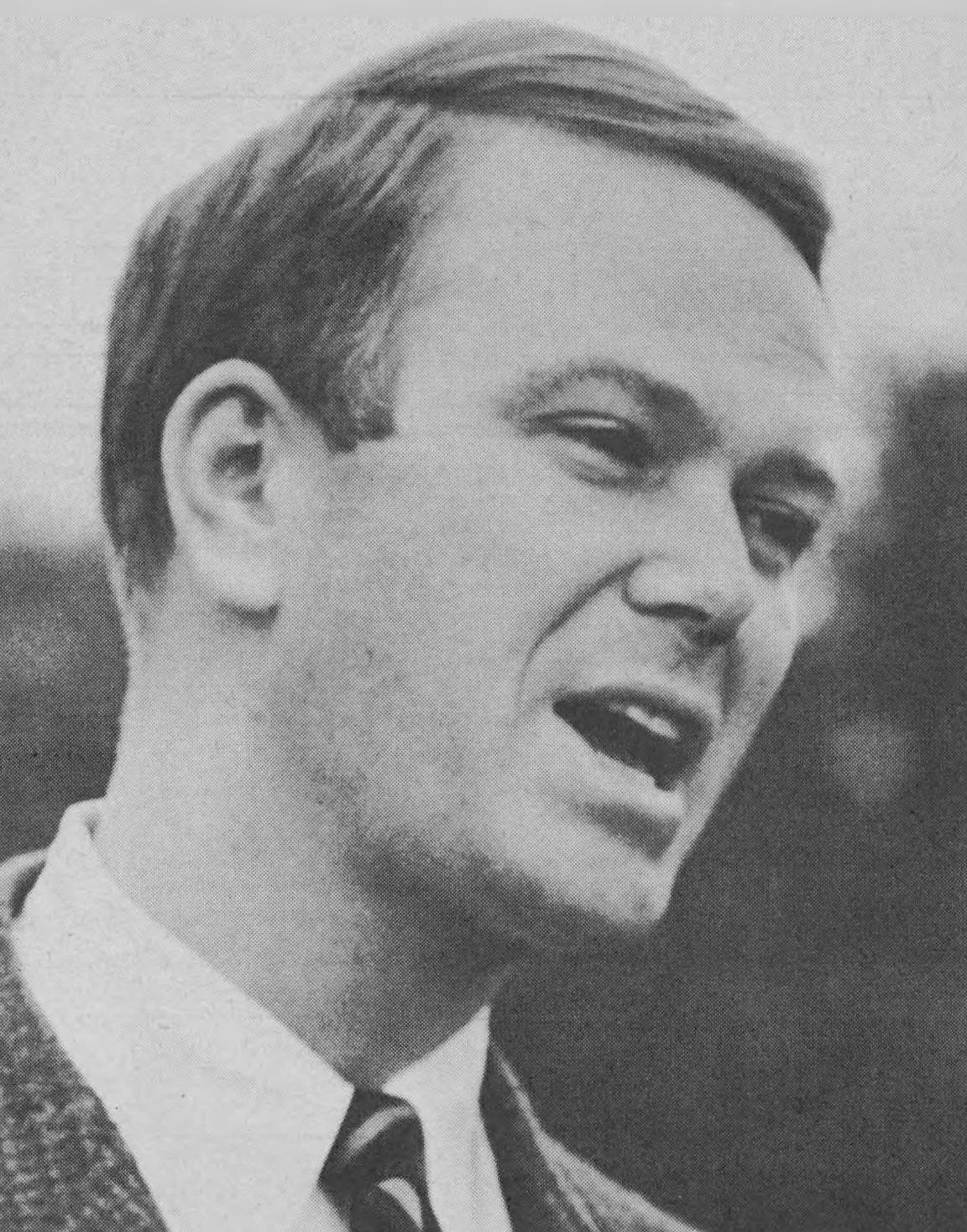
In 1968, Oregon state Rep. Bob Packwood, 36, upset incumbent U.S. Sen. Wayne Morse, making Packwood the youngest senator in the country at the time. (Courtesy Oregon Secretary of State)
When he reached the U.S. Senate, Packwood demonstrated an independence from his party that is nearly nonexistent in the GOP today. He was quite the maverick: moderate, independent and opportunistic. After the Richard Nixon White House finally released the Watergate tapes in 1974, Packwood was so apparently shaken by what he read—“In all the years I’ve been in politics, I’ve never seen such an amoral attitude”—that he called the bureau chief of the Los Angeles Times to broadcast that he would be the first Senate Republican to call for Nixon’s impeachment.
Packwood was also the first senator to introduce a bill to legalize abortion (he could not find a co-sponsor in 1970, three years before Roe v. Wade). He would later break ranks with his party to oppose the nominations of Robert Bork and Clarence Thomas to the Supreme Court of the United States, citing their opposition to abortion.
If those seemed to be bold stands on principle, they were also glorious fund-raising opportunities for Packwood among feminists. Gloria Steinem, co-founder of Ms. magazine, raised almost $600,000 for the Republican’s 1980 reelection campaign.
As chairman of the Finance Committee, Packwood engineered unanimous consent on the Tax Reform Act by meeting quietly, 90 minutes before the full committee convened, with three prime movers from each party.
All the major changes, Packwood later said, “we’re doing in the back room. We’re not doing this in the daylight at all. People are willing to give things up for the good of the country if they’re not going to be hauled over the rack right away.”
In the daylight, meanwhile, Packwood made huge gains with environmentalists in the mid-’70s when he stopped the damming of the Snake River and helped to create the Hells Canyon National Recreation Area.
“He opposed those dams when no one else would,” Ric Bailey, head of the Hells Canyon Preservation Council, told me years ago. “He took on an impossible cause and won. Every time I run the river and go through those rapids…I will think of Bob Packwood.”
And he would remember, Bailey added, what happened in 1991 when the senator decided he needed the support of Oregon conservatives to win reelection in 1992: “Packwood moved overnight from our part-time ally to our full-time enemy. He stepped into Pioneer Courthouse Square and told a rally of timber workers that environmentalists were destroying timber communities.”
For more than 20 years, Oregon’s two senators—both Republicans—occupied positions of prominence in the Capitol far above Oregon’s small population and distance from the Beltway.
But nobody looking for gravity and consistency, to be sure, ever confused Packwood with Oregon’s senior senator, Mark O. Hatfield. Hatfield’s iconic stands—his opposition to the war in Vietnam and his 1995 vote against the Balanced Budget Amendment—were lonely vigils. “Packwood? His maverick battles were connected to a large money machine,” Rick Rolf, a longtime Hatfield adviser, once said.
Packwood was particularly deft at exploiting issues that undermined potential rivals. His defense of Israel for years kept a young (and Jewish) Ron Wyden at bay. His passion for abortion protected his liberal flank. He pivoted on balanced budget amendments, term limits and tax code revisions when the wind changed.
“The senator had the gift of a good mind. Nobody can take that away from him,” - Craig Berkman
As a chorus of historians routinely note, he was willing to say or do whatever it took to get elected.
The late Steve McCarthy, founder of Clear Creek Distillery in Portland, often spoke of the phone call he received from Packwood in early 1974. Packwood was worried that Gov. Tom McCall, nearing the end of his second term, might challenge him in the Senate Republican primary. He knew McCarthy, then running the Oregon State Public Interest Research Group, had done his senior thesis at Reed College on the governor and was close to McCall.
“He said, ‘I just want you to know that if McCall runs against me, I’m going to drag his son’s drug problems into the race. I’m going to talk about his drinking,’” McCarthy recalled.
When McCarthy called Ron Schmidt, McCall’s press aide, he said Schmidt told him he was the third person to have heard that threat. McCall never ran for the Senate.
Forever attuned to threats to his own power, Packwood had no pivot or hiding place when, in the aftermath of the Anita Hill hearings, a freelance reporter named Florence Graves began investigating sexual harassment on Capitol Hill. “Sen. Packwood’s name came up repeatedly,” Graves said.
Some of the anecdotes featured the boxed wine Packwood stored in his office refrigerator, and misbegotten embraces. Others were downright predatory. Packwood first jumped Paige Wagers when she was a 21-year-old mail clerk in his Washington office. “He was French kissing me without any warning,” Wagers later told Senate investigators. “It was sort of like a car crash. It took some force to get him to stop.”
He approached her again six years later, in 1981, in the basement of the Capitol. She didn’t feel threatened until he pulled her into an empty office, pushing her toward the couch. She escaped but said a dozen years later, “It had a devastating effect on me personally. I have never had a career since then. I never worked through the injury. I remained frozen in time.”
In July 1992, Graves took her investigation to The Washington Post. Five days before the 1992 election, Graves and fellow Post reporter Charles Shepard arrived in Portland to interview Packwood about the 10 women who were accusing him on the record.
Packwood was well prepared—Elaine Franklin, then his chief of staff, called Graves that summer to say, “Florence, there are no secrets”—but prepared to smear the character and attack the memory of his accusers. That strategy fended off the Post until late November, when the newspaper finally published its powerful story, but sealed Packwood’s political doom.
As more women came forward in the next 24 months and the Ethics Committee began its investigation, Packwood stalled, citing alcohol addiction, until anger got the best of him. He claimed he was a victim of a McCarthy-like witch hunt. He whined that Lauri Hennessey, one of his accusers, wore short skirts in his office. He volunteered pages from his personal diaries to challenge and disparage his accusers.
“The senator had the gift of a good mind. Nobody can take that away from him,” Craig Berkman, a former GOP party chair, observed at the time. “Having said that, we saw that mental acuity go off the deep end in those diaries and in his conduct in the months since the election of ’92.”
The Senate—94% male at the time—eventually decided it could not abide the accusations of a 17-year-old babysitter and the Capitol’s elevator operator, or the ignominy of another Anita Hill hearing. It subpoenaed all of Packwood’s diaries, a demand Packwood fought unsuccessfully all the way to the U.S. Supreme Court.
On Sept. 7, 1995, the six members of the Ethics Committee agreed he was guilty of sexual misconduct and obstruction of justice, and voted for his expulsion.
Packwood resigned hours later. “I am aware of the dishonor that has befallen me in the last three years,” Packwood said, “and I don’t want to visit further that dishonor on the Senate.”
He didn’t completely disappear in the last three decades of his life. He married Elaine Franklin, his former aide. For several comfortable years, he was paid $240,000 annually to lobby for a health care company. He spoke thoughtfully on the 1986 Tax Reform Act. He eventually sold his Dunthorpe home and downsized into a small penthouse overlooking Millennium Plaza Park in Lake Oswego.
But a heartfelt acknowledgement of the dishonor he visited upon so many women?
“He never apologized for all the harm he caused when it first happened, and what he did to shut everyone up,” said Hennessey, who now teaches at the University of Washington.
She added: “The last 30-plus years of anonymity is plenty of punishment for a man who craved the spotlight his entire life. We have choices how we remember people when they pass. Today, I’m going to remember the part of him that was good.”
Packwood is survived by his wife, Elaine; his children, William Packwood and Shyla Moeller; and politics on Capitol Hill that are far more compromised than he ever imagined.