
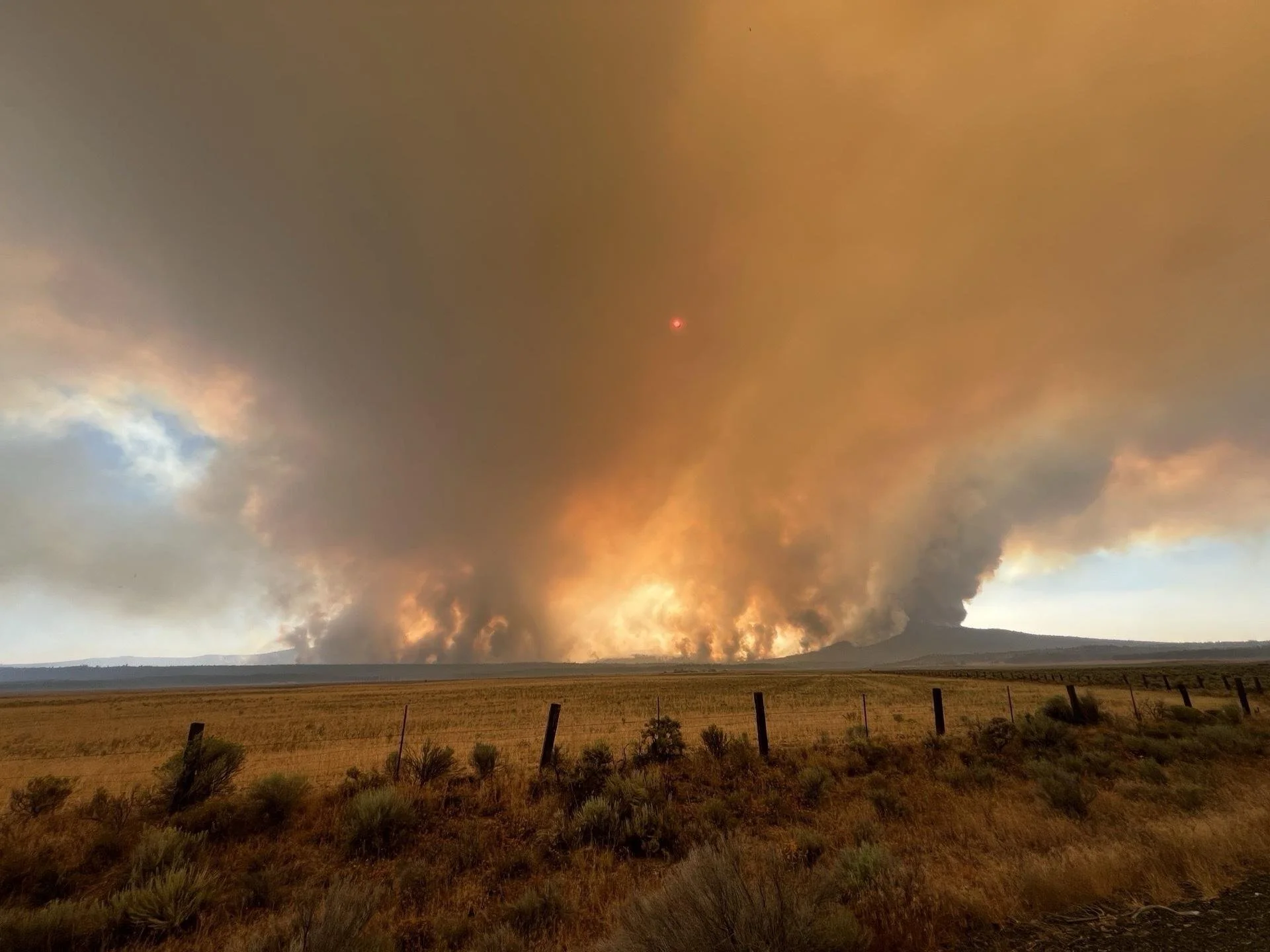
The Wrights Spring Fire as seen on the afternoon of Friday, August 7 from Sprague River Road. (InciWeb)
Five Things to Know About Oregon’s Record Wildfire Season
By Khushboo Rathore
August 28, 2026
Oregon’s unfinished fire season is the most destructive ever, burning more than 2.5 million acres and choking off clean air across the state.
At the same time, Oregonians may misunderstand some aspects of the wildfire crisis, which could leave communities unprepared as fire seasons grow longer and more intense year after year. The Oregon Journalism Project analyzed recent data updated Aug. 24 by the National Interagency Fire Center to dispel some misconceptions.
Most of the destruction takes place on federal land
Since 2020, only 1% of the land damaged by wildfire in Oregon is owned by the state. The bulk of the land that burns every year is federal, managed by either the federal Bureau of Land Management or the U.S. Forest Service. The high proportion of wildfires on federal land isn’t surprising, given that 53% of the land mass in Oregon is federal.
Regardless of ownership, federal and state agencies work together to fight fires across the state, especially when they threaten people and homes, said Oregon Department of Forestry spokeswoman Jessica Neujahr.
“When we’re in seasons, especially like this, it is all hands on deck,” Neujahr said.
Humans cause nearly half of wildfires, but account for a lesser fraction of the total acres burned
This season, 45% of the fires that have a known cause were started by humans. Those causes are many—campfires, burning cigarettes, hot exhaust pipes, even dragging tow chains creating sparks that ignite dry grass or pine needles.
Few of those man-caused fires, however, were intentional. This season, only one of 297 wildfires in Oregon has been deemed arson, though officials have still not determined the cause of fire in about 60 cases. An earlier state study put arson as the cause of 3% of fires.
Fortunately, human-caused wildfires don’t typically grow into large fires, in part because they are less likely to be in remote parts of the state. People spot and report them earlier, and crews can get to them more easily.
Fires caused by lightning are usually the biggest
Fires ignited by natural causes like lightning are responsible for Oregon’s megafires (blazes of more than 100,000 acres) and often occur in rural or forested areas. They spread depending on winds, humidity and temperature. Because of their remoteness, fighting them can be particularly challenging.
The Big Grass Fire in southeastern Oregon, which started from a lightning strike on BLM land in late July, burned through more than half a million acres in a month.
This summer, the most common fuel for wildfires is not timber
While more than half of the acres in Oregon that are considered high risk to wildfire are forests, most of the acres burned this summer were covered by dry brush and grass. Short grass has been the primary fuel source for 1.8 million acres of the record 2.5 million acres burned in 2026.
Grass and brush tend to be “flashy fuels,” Neujahr said. They burn short and hot but can spread fire much faster than other fuels.
Timber, which is the main fuel source for the ongoing 50,000-acre Wrights Spring Fire in Klamath County, burns longer and is harder to extinguish.
“It moves from the crown of one tree to the crown of the next tree to the crown of the next tree,” Neujahr said, “and you can’t fight a fire that’s 30 feet in the air.”
Prescribed burns are rare in Oregon
Managed burning of dry vegetation, brush and grass can help reduce the intensity of fires when they occur. Some feel that this sort of mitigation could be employed more in Oregon. One is Matt Donegan, a former timber investment company executive who now chairs the Oregon Environmental Quality Commission.
Donegan is currently building a forest management plan that will model how much prescribed burning and thinning the state should be doing, with an eye toward treating 30% to 40% of the 13 million high-risk acres in Oregon.
In a November interview with OJP, Donegan said: “We’ve got a huge backlog of excess fuels owing to a century of management where we were suppressing every fire that came out and also not adequately thinning and not adequately maintaining fire regimes.”
Data from the National Interagency Fire Center shows prescribed burns in Oregon have taken place on only 7,000 acres over the past five years.