
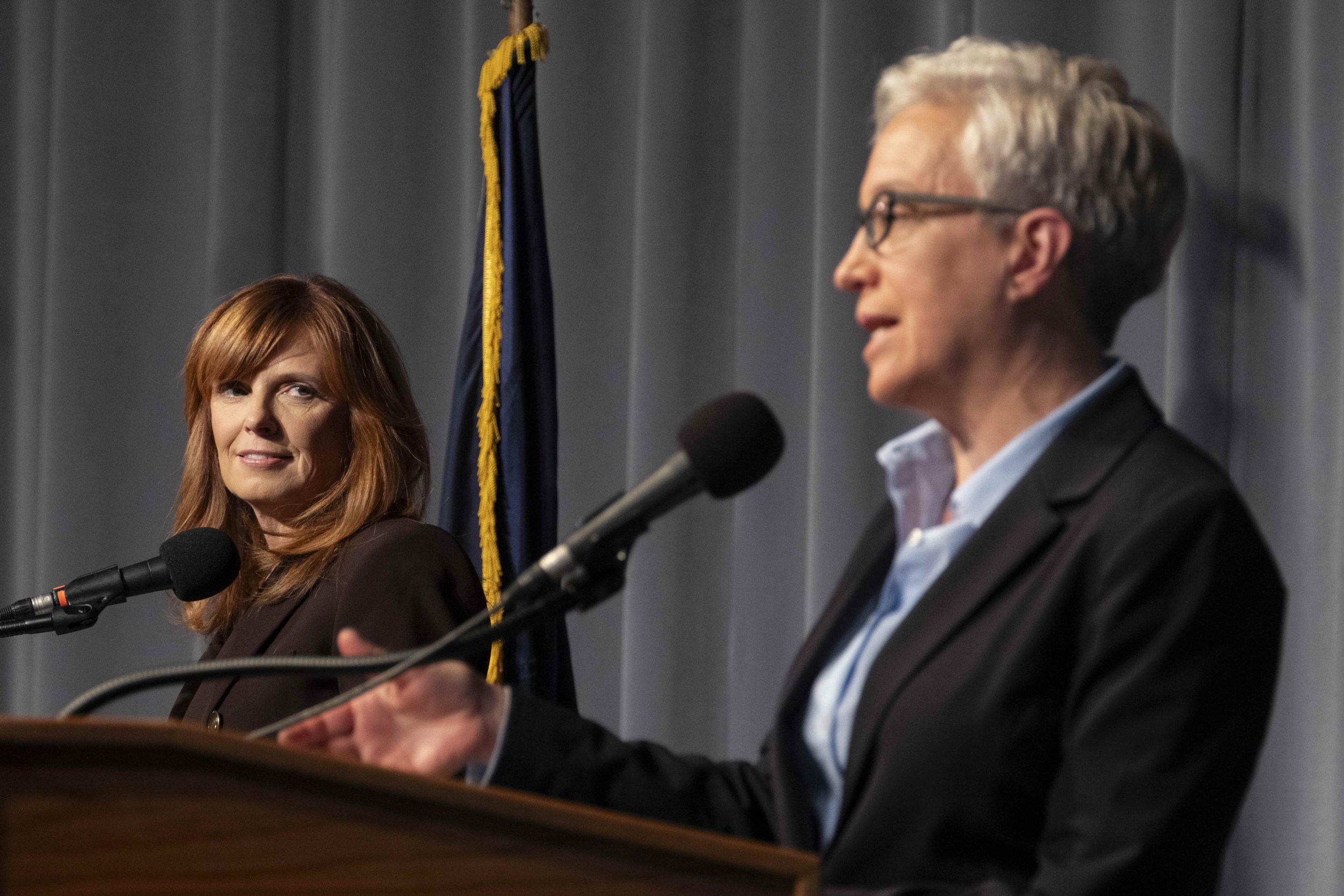
Sen. Christine Drazan and Gov. Tina Kotek faced off in the first of three debates (Will Yurman / Lookout Eugene-Springfield)
First Oregon Governor’s Debate Gets Feisty
Gov. Tina Kotek and state Sen. Christine Drazan trade barbs and call each other disingenuous.
By Penny Rosenberg
October 1, 2026
At the first gubernatorial debate of 2026, Gov. Tina Kotek and Republican challenger Christine Drazan both said they believe Oregonians are struggling but for different reasons—with the incumbent blaming President Donald Trump and the state senator blaming Gov. Kotek.
The first of three this election season, the debate held in a closed-door meeting room-turned-TV studio in Eugene on the University of Oregon campus was feisty, with the candidates regularly taking swipes at each other.
“I don't know if the governor is advancing a drinking game tonight, but I'm a little bit tired of her pushing everything off on the federal administration,” Drazan said.
“Well, I'm really tired. You actually are just, like, distorting the truth,” Kotek shot back after discussing a question about voting by mail. Kotek said she wouldn’t change the current system, while Drazan said she wants to return polling booths to Oregon.
While in the House in 2025, Drazan sponsored House Bill 3872, which would have made in-person voting the “normal method for voting” and offered absentee ballots only to voters who couldn’t make it to the polls on election day. It also required showing government ID, both goals of Republicans nationally, especially after Trump’s defeat in 2020. It did not advance.
Later in the debate, Drazan was asked directly who won the 2020 presidential election. Drazan simply said “Biden,” a substantial departure from many Republicans who still are unwilling to concede that.
Amid a national political environment in which Republican pundits fear a “blue wave”—Reuters reported Oct. 1 that Democrats in red states view the 2026 midterm election as a “once-in-a-generation” opportunity—the race for governor in Oregon is a toss-up, according to the latest polling.
Oregon hasn’t had a Republican governor since Vic Atiyeh, who was reelected to a second term in 1982, long before partisan media bubbles or even the internet.
Kotek invoked the president’s name 13 times, but Drazan did not take the bait.
“The only person that I'm interested in this election is defeating Tina Kotek,” she said, “and ensuring that Oregonians actually have a voice and a chance to thrive in their future. She is crushing the hopes and dreams of Oregonians.”
Over the course of the hourlong debate, the candidates faced questions from Nigel Jaquiss of the Oregon Journalism Project, Ben Botkin from Lookout Eugene–Springfield, and Bayla Orton, a student journalist at the University of Oregon. Questions covered housing, affordability, data centers, education and more, with Kotek touting initiatives underway and warning that her opponent’s record represents a “risk” for the state, and Drazan asking for a chance to clean house by focusing on fixing problems without new taxes.
Here’s a rundown:
Housing
Drazan said Kotek has fallen far short of her own housing goals, and focused on “availability of land to build on,” she said. “We can protect high valley farmland, forest land, and maintain Oregon's commitment to our environment while not constricting the availability of housing; we have got to advance permits and ensure that permitting is expedited.
Kotek insisted that although the state has not built as many homes as she promised when she was first elected governor, the state is producing more homes “because of the work that we have been doing here to streamline permitting, reducing red tape, investing in infrastructure, helping our communities plan better to have the housing that they need.”
Data centers
Both candidates have modified their position on data centers in recent weeks as public opinion has shifted dramatically in opposition. Both candidates now support a moratorium, and neither candidate was able to articulate a clear policy.
Drazan advocated for “a different kind of relationship with the data centers that are coming forward in our state right now.” She said leaders should ensure that future data centers offer a “shared community benefit” and that the communities where they are proposed want them. There “should never be a data center shoved down the throat of any community across Oregon.”
Kotek was also largely unspecific, adding that on day one, if she is reelected, she will introduce a bill requiring the centers to produce their own energy, and that it be clean energy, built by union labor, and that they provide benefits in those communities.
Affordability
When asked how to tackle affordability, Kotek explained that as governor, she would be a consumer watchdog.
“It's about going after hidden fees,” she said. “It's about standing up to grocery stores who want to surveil your activity and change their prices accordingly. You have to do all those things and make sure that corporations do not take advantage of Oregonians who are struggling.”
Drazan, however, had a different strategy: “The best thing that can be done for Oregonians to address affordability is to ensure that Tina Kotek does not get a second term, as she solves every single challenge that she sees, every single problem in the state of Oregon with a new tax.”
Climate protection
Oregon’s Climate Protection Program is viewed as wildly out of step with the rest of the country. Earlier this year, the governor’s own Prosperity Council recommended this summer that Oregon replace the current CPP, which funnels polluters’ fees through a nonprofit to groups affected by climate change, with a cap-and-invest model favored by other West Coast states.
When asked if she supported her council’s recommendation, Kotek hedged, saying, “I am 100% supportive of our current Climate Protection Program because it is going to help us reduce our carbon pollution here in the state,” while adding, “I am supportive of the Legislature taking this up next year to figure out how we might be able to be more competitive.” But in the meantime, CPP stays in place, she said.
Drazan was clear and said, “I will rescind Tina Kotek's Climate Protection Program on day one.…We cannot afford to continue to advance a political agenda that harms families and makes us uniquely expensive.”
Education
Both candidates were asked why Oregon’s educational results were so poor given that Oregon spends more money per student than many states. Kotek maintained she is making progress and called attention to the fact that “I passed an accountability bill that says we should have statewide performance standards. I think we need to reduce our chronic absenteeism in the state. We have to track it better. We have to help our districts help get our students back in the classroom. That is why I've fought since day one to do things like investing in early literacy. We are seeing improvements in our districts.”
Drazan placed the blame on Kotek: “She voted to remove graduation standards. She kept our schools shut down for longer than anywhere else in the nation [during COVID-19]. As she has advanced politics inside the classroom, she hasn't kept teachers safe inside the classroom. The issues that we face in our schools right now can be laid at the feet of the sitting governor; there's no other way around it.”
Some of the debate questions proved a struggle to get clear answers. Both candidates were asked about the lack of financial support for higher education (Oregon ranks 46th in state support for public universities) and were also asked if Phil and Penny Knight’s gift of $1 billion for a new engineering school in Eugene makes sense, given that Oregon State University, up the road in Corvallis, has one of the largest engineering schools in the country. While Drazen did say the state needed to avoid redundancy, Kotek largely avoided the question altogether.
The two are expected to face off again in Medford (Oct. 7) and Bend (Oct. 13).